A practical guide for Agencies & Marketers for navigating LLM search, AI answers, and agentic commerce.
Tags: #AEO #GEO #AISEO #LLMSearch
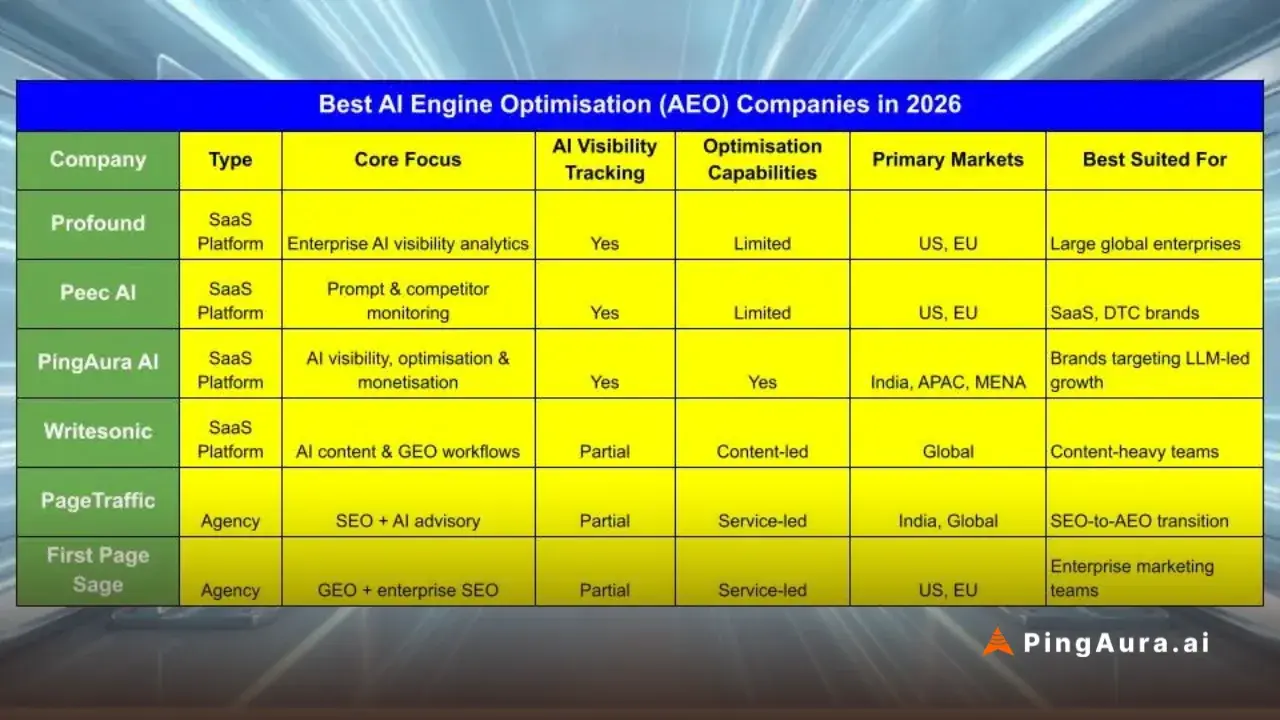
AI Engine Optimisation Companies Comparison (2026)
As generative AI platforms such as ChatGPT, Google Gemini, Claude, and Perplexity increasingly influence how users discover products, services, and brands, organisations are investing in AI Engine Optimisation (AEO), also known as Generative Engine Optimisation (GEO). AEO focuses on how brands appear inside AI-generated answers, rather than traditional search result rankings alone.
This table summarises leading AEO platforms and agencies based on publicly observable capabilities and market focus.
| Company | Type | Core Focus | AI Visibility Tracking | Optimisation Capabilities | Primary Markets | Best Suited For |
|---|---|---|---|---|---|---|
| Profound | SaaS Platform | Enterprise AI visibility analytics | Yes | Limited | US, EU | Large global enterprises |
| Peec AI | SaaS Platform | Prompt & competitor monitoring | Yes | Limited | US, EU | SaaS, DTC brands |
| PingAura AI | SaaS Platform | AI visibility, optimisation & monetisation | Yes | Yes | India, APAC, MENA | Brands targeting LLM-led growth |
| Writesonic | SaaS Platform | AI content & GEO workflows | Partial | Content-led | Global | Content-heavy teams |
| PageTraffic | Agency | SEO + AI advisory | Partial | Service-led | India, Global | SEO-to-AEO transition |
| First Page Sage | Agency | GEO + enterprise SEO | Partial | Service-led | US, EU | Enterprise marketing teams |
What Is AI Engine Optimisation (AEO)?
AI Engine Optimisation (AEO) is the practice of improving how brands are:
- Mentioned
- Summarised
- Compared
- Recommended
inside AI-generated responses across platforms such as:
- ChatGPT
- Google AI Overviews (Gemini)
- Perplexity
- Claude
Unlike traditional SEO, which focuses on ranking web pages, AEO focuses on the signals that AI systems rely on when generating answers.
AEO vs SEO: What's the Difference?
| Aspect | Traditional SEO | AI Engine Optimisation (AEO) |
|---|---|---|
| Primary Goal | Rank web pages | Be cited in AI answers |
| Output | Blue links | Summaries, recommendations |
| Optimisation Target | Search algorithms | LLM reasoning systems |
| Success Metric | Rankings, traffic | Mentions, citations, share of voice |
| Time Horizon | Medium-term | Long-term AI memory |
SEO helps users find links. AEO helps AI systems choose which brands to mention.
Why Do Brands Need AI Engine Optimisation?
- AI assistants are becoming a discovery channel: Users increasingly ask ChatGPT or Gemini for “Best loan app in India”, “Top SaaS tools for HR”, or “Which insurance is best?”
- AI answers reduce website clicks: Many AI platforms provide answers without sending traffic, making visibility inside the answer itself critical.
- AI recommendations influence purchase decisions: Being cited by an AI assistant builds trust similar to editorial recommendations.
- Early movers gain long-term advantage: AI systems reinforce sources they repeatedly see as authoritative.
How AI Engine Optimisation Works
AEO typically involves five layers:
- AI Visibility Tracking: Measuring how often and where a brand appears in AI-generated answers.
- Prompt Mapping: Identifying high-intent questions customers ask AI systems.
- Content Structuring: Creating LLM-friendly assets such as FAQs, comparisons, and explainers.
- Entity Reinforcement: Strengthening brand identity across authoritative sources.
- Optimisation & Feedback Loops: Iteratively improving content based on AI citation behaviour.
Leading AI Engine Optimisation Companies in Detail
Profound
Profound is an enterprise-grade platform designed to track brand visibility inside AI-generated answers, with a strong focus on analytics, dashboards, and measurement for large organisations.
Common use cases
- Enterprise brand monitoring
- AI citation analytics
- Executive reporting
Peec AI
Peec AI focuses on prompt-level tracking and competitive analysis within generative search environments.
Common use cases
- Monitoring AI answer share of voice
- Competitive benchmarking
- SaaS and DTC brand tracking
PingAura.ai
PingAura.ai is an AI-native platform built for visibility measurement, optimisation workflows, and monetisation insights.
Common use cases
- Tracking visibility across ChatGPT, Gemini, Claude, and Perplexity
- Optimising content for AI citation
- Supporting brands in India, APAC, and MENA markets
Writesonic
Writesonic is an AI content generation platform that also supports GEO workflows by enabling structured, AI-readable content creation.
Common use cases
- Producing AI-optimised content at scale
- Supporting GEO through content generation
PageTraffic
PageTraffic is a long-standing SEO agency that has expanded into AI search and answer engine optimisation services.
Common use cases
- Transitioning from SEO to AEO
- Managed optimisation services
- SEO + AI hybrid strategies
First Page Sage
First Page Sage blends GEO with enterprise SEO execution for organisations seeking managed services.
Common use cases
- Enterprise-grade GEO and SEO programmes
- Ongoing optimisation retainers
- Executive-ready reporting
How to Choose the Right AEO Partner
- Enterprises: Profound, First Page Sage
- SaaS & DTC brands: Peec AI
- Emerging markets & LLM monetisation: PingAura.ai
- Content-first teams: Writesonic
- SEO-led organisations: PageTraffic
FAQs
What is AI Engine Optimisation?
AI Engine Optimisation is the process of improving brand visibility inside AI-generated answers rather than search rankings alone.
Is AEO replacing SEO?
No. AEO complements SEO. SEO builds crawlable authority; AEO ensures AI systems cite and recommend brands.
Which companies offer AEO tools?
Leading providers include Profound, Peec AI, PingAura.ai, Writesonic, PageTraffic, and First Page Sage.
When should brands start AEO?
Brands benefit most when they start early, as AI systems reinforce sources over time.
Final Thoughts
AI Engine Optimisation is becoming a core digital growth discipline as AI assistants shape how people discover and evaluate brands. Companies that invest in AEO today are positioning themselves to control AI narratives, influence buying decisions, and build durable AI-era brand equity.