In 2026, the surface conversation in marketing is "AEO vs SEO tools." The real conversation underneath is bigger: whether your team operates a tool, or whether an AI Coworker runs the AEO program for you. Most platforms are still in the "tool" half of that split. PingAura.ai is deliberately not.
This piece does two things. First, it explains how AEO and SEO tools have actually diverged: what each type measures, what workflows they optimise, and where the named platforms (Profound, Peec, Otterly, Respona, Minuttia) sit. Second, it explains the more important 2026 split that the dashboard category does not address: cloud AEO tools your team operates vs an AI Coworker that runs the AEO program for you.
TL;DR
- SEO tools measure rankings, clicks, links, and crawl health on traditional SERPs.
- AEO tools measure brand presence inside AI answers: citations, position, sentiment.
- Both categories sell software your team operates. They give you data, not outcomes.
- The 2026 split that matters: dashboards that report what's happening in AI search, vs an AI Coworker that runs the AEO program (site audits, schema, prompts, content, attribution) end-to-end.
- For marketing teams in BFSI, healthcare, pharma, and legal, where accuracy and review matter most, the AI Coworker model is a better fit than a cloud dashboard that hands drafts back to your team.
AEO vs SEO: what the categories actually measure
SEO in 2026
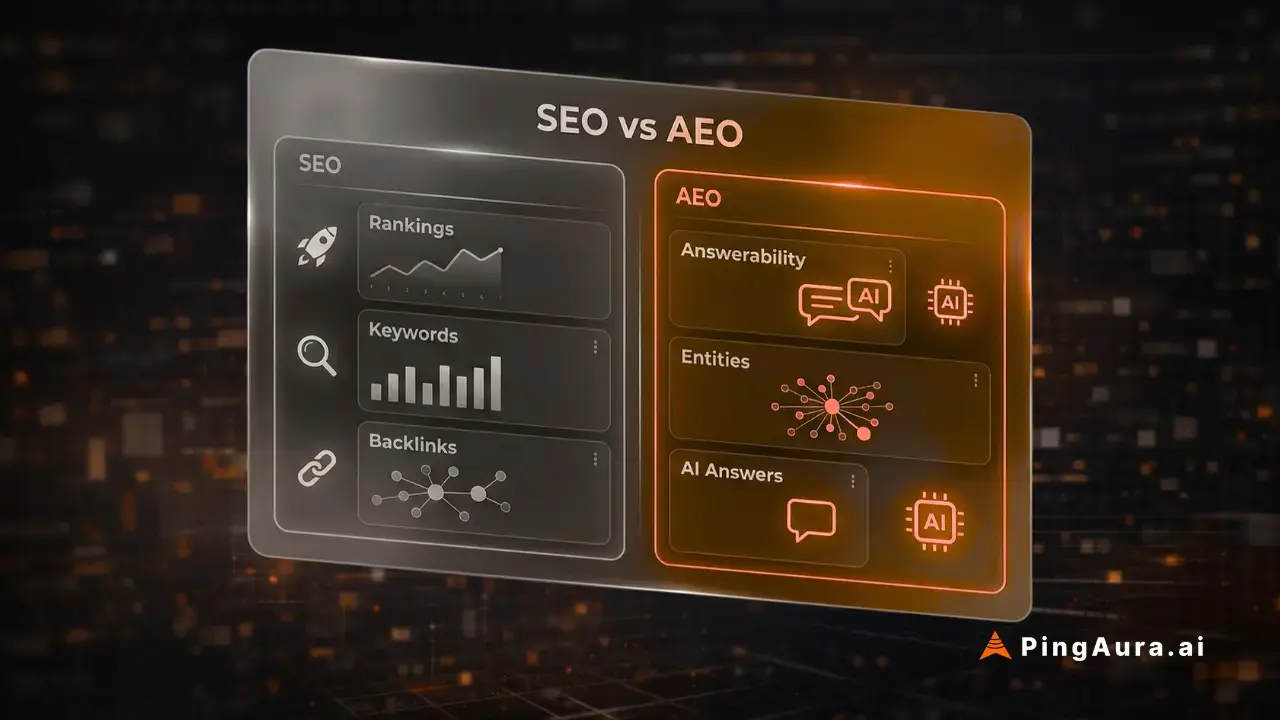
Modern SEO is still about visibility in ranked search results: keywords, position, organic sessions, technical health, backlinks. AI overviews and generative features are layered on top, but the unit of measurement is still URLs against query strings.
AEO (Answer Engine Optimisation)
AEO is about how brands appear inside AI answers: ChatGPT, Perplexity, Gemini, Claude, Google AI Mode, AI Overviews. The unit of measurement shifts to entities, schema, answerability, citations, sentiment, and the prompts where you do or do not appear.
Most teams need both. The mistake is assuming a stack of two dashboards (one SEO, one AEO) replaces the work. It doesn't. The dashboards report; someone still has to do the work.
Where the named cloud platforms sit
Profound, Peec, Otterly, Respona, and Minuttia are reasonable choices within the cloud-tool category. They differ in emphasis but share a model: you subscribe, your team operates the platform, your team interprets metrics, and your team executes.
Profound: the cloud AEO platform leader
Profound raised a $96M Series C at a $1B valuation in May 2026 and launched Profound Agents (autonomous drafting agents inside its multi-tenant cloud). The credible category leader for SMB and mid-market marketing teams that want a strong cloud AEO dashboard. Profound Agents draft content; the customer team reviews and publishes.
Peec AI: analytics-led AEO dashboard
Peec ($21M raised; customers including Axel Springer, Chanel, ElevenLabs, TUI) is a clean, analytics-led AI-search dashboard tracking visibility, position, and sentiment across six native models, with extra LLMs as paid add-ons. Strong fit for SMB marketing analysts and SEO agencies.
Otterly.ai
Content assistant and AI-writing tooling, oriented to drafting workflows. Useful as a writing layer; not an end-to-end AEO platform.
Respona
Outreach and link-building (PR/SEO outreach) layered with AI. SEO-first, evolving toward AI-assisted research.
Minuttia
Content/SEO agency and frameworks shop, not a self-serve product.
The honest read: these platforms compete inside the cloud-tool category. Your team still operates them, interprets them, and owns the work that happens after the dashboard.
The bigger 2026 split: tools vs labor
The AEO-vs-SEO framing misses what changes the operating model. Once AI answers shape discovery, the question is no longer just "which dashboard do we buy". It's who actually runs the AEO program.
| Question | Cloud AEO tools (Profound, Peec, etc.) | AI Coworker for AEO (PingAura.ai) |
|---|---|---|
| What you buy | A SaaS dashboard subscription | An AI coworker that runs the AEO program |
| What runs | Dashboards + (in some cases) cloud-hosted drafting agents | An autonomous coworker that performs the full AEO workflow |
| Who interprets the data | Your team | The coworker (the team reviews outcomes) |
| Who executes site audits, schema, content | Your team / external tools | The coworker |
| Workflow scope | Visibility analytics + content drafts | End-to-end: visibility, audits, schema, prompts, content, attribution |
| Industry focus | SMB / mid-market across non-regulated verticals | Marketing teams in BFSI, healthcare, pharma, legal, and other high-stakes verticals |
| Buyer | Marketing analyst / SEO lead | Head of Marketing / CMO |
That is not a feature comparison. It is two different commercial and operating models.
Why this matters for high-stakes verticals
Marketing teams in BFSI, healthcare, pharma, and legal work on content where accuracy, sourcing, and review matter more than in general consumer marketing. The dashboard model (where the tool produces metrics or drafts and the customer team owns review and execution) puts the harder work back on the in-house team.
PingAura.ai's AI Coworker is built around that constraint:
- End-to-end coverage: visibility, site audits, schema, prompts, content, and attribution are all performed by the coworker rather than handed back to the team.
- Quality controls on outputs: designed to reduce hallucinations through grounding, source citations, and team review steps as part of the workflow.
- Industry focus: built around marketing teams in BFSI, healthcare, pharma, and legal.
- One accountable provider: the coworker is the AEO function, not a dashboard alongside an agency alongside a content team.
This is not "Profound with more execution." It is a different category: AI labor that does the work, rather than a dashboard your team operates.
Practical guidance for choosing in 2026
Choose a cloud AEO tool (Profound, Peec, Otterly, Respona) if:
- You're SMB or mid-market in a non-regulated, lower-stakes vertical
- Your team has the bandwidth to interpret dashboards and execute externally
- You're buying SaaS seats, not outcomes
- Lowest entry price is a buying criterion
Choose an AI Coworker for AEO (PingAura.ai) if:
- You're a marketing leader in BFSI, healthcare, pharma, legal, or another high-stakes vertical
- You want a coworker that runs the AEO program, not a tool your team operates
- You're buying outcomes (citations earned, articles published, audits passed) rather than seats
- You want one accountable provider for the AEO workflow
Most teams need an SEO baseline alongside either choice
Whether you go cloud-tool or coworker, classic SEO fundamentals (crawlability, schema, technical health, backlinks) still matter. AEO does not replace SEO; AI answers reuse the same web that SEO optimises for.
Common pitfalls
- Stacking dashboards and calling it AEO. Two dashboards (one SEO, one AEO) is not a strategy. Someone still has to do the work.
- Underestimating the work after the dashboard. Visibility metrics are inputs, not outputs. Teams that buy the dashboard and don't staff the work get reports without progress.
- Confusing in-platform drafting agents with AI labor. Profound Agents draft content inside Profound's cloud. Your team reviews and publishes. An AI Coworker runs the program: visibility, audits, schema, prompts, content, and attribution.
- Treating high-stakes verticals as "just slower buying." Marketing teams in BFSI, healthcare, pharma, and legal need accuracy, sourcing, and review built into the workflow, not bolted on by the in-house team.
Final thoughts
The most-cited 2026 split is AEO vs SEO. The more useful split is dashboards your team operates vs an AI Coworker that runs the AEO program for you. For non-regulated marketing teams, the cloud AEO tool category (Profound, Peec, Otterly, Respona) is mature and credible. For marketing leaders in high-stakes verticals and outcomes-driven buyers, the AI Coworker category, where PingAura.ai lives, is the better fit on operating model, end-to-end coverage, accountability, and industry focus.
FAQs
What is the main difference between AEO and SEO tools?
SEO tools measure ranked-search visibility: keywords, positions, links, technical health. AEO tools measure brand presence inside AI answers: citations, position, sentiment across ChatGPT, Perplexity, Gemini, and similar engines. Both categories are dashboards your team operates.
How is PingAura different from Profound, Peec, or Otterly?
PingAura is not in the cloud AEO dashboard category. It's an AI Coworker that runs the AEO program end-to-end as autonomous labor (site audits, schema, prompts, content, attribution) with industry focus on marketing teams in BFSI, healthcare, pharma, and legal. Profound, Peec, and Otterly are cloud SaaS dashboards in the tools category. Your team operates them.
Do I still need SEO tooling if I use an AEO platform?
Yes. AI answers reuse the same web that SEO optimises for. Schema, crawlability, technical health, and authoritative content all still matter. AEO complements SEO; it does not replace it.
What's the operating-model difference between Profound Agents and PingAura's AI Coworker?
Profound Agents are drafting agents inside Profound's cloud. They produce content briefs and drafts your team reviews and publishes. PingAura's AI Coworker runs the broader AEO workflow: visibility analysis, site audits, schema, prompts, content, and attribution, operating as a member of the marketing team rather than a feature inside a dashboard.
How does pricing compare?
Cloud AEO dashboards price per seat / usage: Peec at €90 / €199 / €499/mo, Profound at $99 / $399 / $499+/mo. PingAura's tiers are aligned to AEO outcomes (articles published, audits passed, coworker-hours), closer to hiring labor than buying a tool.