TL;DR
ChatGPT is evolving quickly and is no longer just a place to get answers. It is becoming a place where decisions happen, and consequentially, advertising follows.
- ChatGPT ads are sponsored messages inside conversations
- They appear after, within, or below responses
- They rely on real-time intent instead of user tracking
- Major brands like Adobe, Target, and Ford are already testing them
- Ads are currently concentrated in the U.S. but expanding globally
- This marks a shift from search engines to answer engines
- Brands must adapt to AI-driven discovery
- PingAura helps brands succeed in this new landscape
What are ChatGPT ads?
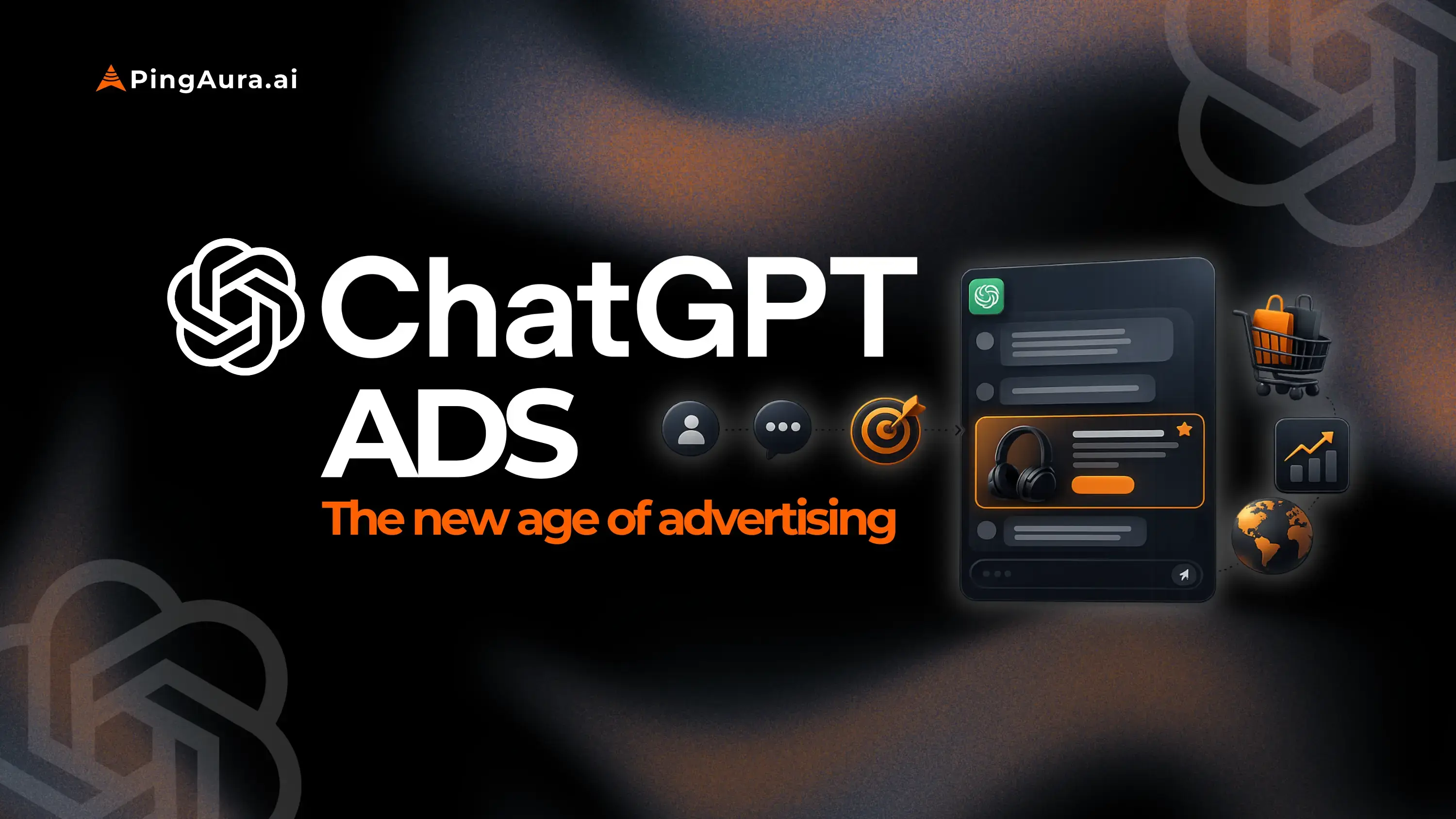
ChatGPT ads are sponsored messages placed directly inside AI conversations. OpenAI formally outlined the buying surface in its new ways to buy ChatGPT Ads announcement, which opened a self-serve Ads Manager, CPC bidding, a measurement pixel, and a Conversions API for advertisers. These are very different from traditional digital ads. You will not see banners, pop-ups, or sidebars. Instead, ads are built into the flow of a conversation. They appear in a way that feels natural and relevant to what the user is asking.
These ads can show up as:
- Sponsored cards that appear after an answer
- Suggested products or services inside a response
- Sponsored links placed below replies
Each ad is clearly labeled as "Sponsored," which helps maintain trust.
What makes these ads powerful is timing. They are shown at the exact moment a user expresses intent. When someone asks a question, they are already thinking about a solution. ChatGPT ads meet users at that moment.
Where do ChatGPT ads appear?
Unlike traditional platforms where ads interrupt the experience, ChatGPT places ads within the interaction. This makes them feel less intrusive and more relevant.
After the AI response
After ChatGPT answers a question, a sponsored card may appear below the response. This placement works well because it comes right after the user gets information and may be ready to act.
Inside the conversation
In some cases, a product or service may be suggested within the response itself. These suggestions are still clearly labeled as sponsored content.
At the bottom of replies
Some ads appear as simple sponsored links at the end of answers. These are less prominent but still aligned with the user's intent.
Limited to certain users
At present, ads are mainly shown to users on free or low-cost plans. Paid users typically have an ad-free experience. This controlled rollout helps maintain user trust while testing the format.
How do ChatGPT ads work?
ChatGPT ads rely on real-time context, not long-term tracking. This is one of the biggest shifts in digital advertising. Instead of tracking users across the internet, ChatGPT focuses on what the user is asking right now.
Context-based targeting
Ads are selected based on the current conversation. If a user asks about running shoes, they may see ads for sports brands. If they ask about travel, they may see hotel or airline offers.
Privacy-first approach
ChatGPT does not rely on sensitive personal data to serve ads. It focuses on immediate intent rather than past behavior.
Real-time matching
The system uses AI to match user queries with relevant advertisers in real time. This makes ads feel more useful and less random.
Separation from answers
Importantly, ads do not change the actual answer. The AI response remains independent, and ads are clearly marked. This balance is critical. If users feel that answers are biased, trust will break. Right now, the system is designed to avoid that.
Who's already using ChatGPT ads and where?
Large global brands and agencies are leading adoption, mainly in the United States, within live conversational environments. ChatGPT ads are still in an early stage, but adoption is already strong among major advertisers. These early players are using the platform to test how conversational advertising performs compared to traditional channels.
Leading brands
Several well-known companies have entered early pilots, including:
- Adobe
- Target
- Audible
- Ford
- Mazda
- Best Buy
- Expedia
- Qualcomm
These brands come from industries where intent is strong, such as retail, travel, and automotive. This is not a coincidence. ChatGPT works best when users are actively looking for solutions.
Role of agencies
Large advertising groups are also playing a key role. Agencies like WPP, Omnicom, and Dentsu are bringing multiple clients into the ecosystem. This shows that ChatGPT ads are not just experimental. They are being integrated into broader media strategies.
Where ads are live
Right now, most ChatGPT ads are running in:
- United States (primary market)
- Early expansion markets like Canada and Australia
Within these markets, ads appear directly inside ChatGPT conversations, including responses and follow-ups.
Scale of adoption
Early data suggests:
- Hundreds of advertisers have already joined
- Many are increasing spend after initial tests
This signals strong early performance and growing confidence in the format.
How is it going right now?
ChatGPT ads have shown promising early traction. Revenue has scaled quickly during testing, and advertiser interest continues to grow.
Several factors are driving this momentum:
- Users on ChatGPT show high intent
- Ads are placed at decision-making moments
- Engagement quality is higher than traditional display ads
However, it is still early. The rollout is limited, and many features are still being tested. There is also some debate in the industry. While many companies are embracing ads in AI, others are cautious about how it could impact user trust.
What will ChatGPT ads look like soon?
Moving forward, these ads will be more scalable, more integrated, and more conversational. The next phase of ChatGPT ads will focus on expansion and usability.
Here is what to expect:
- Global rollout: More countries, including India, are expected to see ads soon.
- Self-serve platforms: Brands will be able to launch and manage campaigns directly, similar to Google Ads or Meta Ads.
- Broader advertiser base: Small and mid-sized businesses will begin to participate as access expands.
- Better relevance: Ads will become more helpful and aligned with user needs.
- Conversational commerce: Users will increasingly be able to take action, such as making a purchase, without leaving the chat.
This is where advertising and commerce begin to merge.
What does this mean for brands?
The way people discover products is changing, and brands must adapt. ChatGPT signals a shift from search engines to answer engines. This has deep implications for marketing strategy.
- Intent matters more than volume. Fewer users may see your brand, but those who do are more likely to act.
- SEO alone is not enough. Ranking on Google is no longer the only goal. Brands must also be visible inside AI-generated answers.
- The funnel is being compressed. The journey from question to action is becoming shorter. Users may move from asking to buying in a single interaction.
- Trust is critical. AI systems prioritize credible and relevant brands. If your brand lacks authority, it may not appear at all.
- Competition is shifting. You are no longer just competing for clicks. You are competing to be included in answers.
How can PingAura help here?
AI visibility is now a core growth channel and PingAura is built for this new environment.
It helps brands:
- Appear inside AI-generated answers
- Optimize content for conversational search
- Track how AI drives traffic and revenue
- Run and manage AI-native ad strategies
- Enable agent-driven commerce experiences
ChatGPT ads are only one piece of a larger shift. PingAura approaches this shift as a full AI Search and Monetisation platform, not just an advertising tool.
FAQs
Which brands are already using ChatGPT ads?
Large brands such as Adobe, Target, Ford, and Expedia are among early adopters.
Where are ChatGPT ads currently available?
They are mainly available in the United States, with expansion into countries like Canada and Australia.
Do ChatGPT ads use personal data?
They primarily rely on the context of the current conversation rather than personal history.
Do ads affect the answers generated by ChatGPT?
No. Ads are clearly separated and do not influence the response.
When will ChatGPT ads expand globally?
Expansion is expected to continue through 2026, including markets like India.
Is this the future of advertising?
It is highly likely, as AI interfaces are becoming a primary way people find information.
Conclusion
ChatGPT ads represent more than a new format. They represent a new model of discovery. Instead of searching through links, users are now receiving direct answers. And within those answers, brands have a chance to be present at the exact moment of intent.
This shift changes everything. It reshapes how users explore options, how brands communicate value, and how decisions are made. We are moving into a world where visibility is no longer about ranking pages. It is about being included in the answer itself.
Already shipping inside PingAura
Since this guide went live, the OpenAI Ads API has opened to self-serve buyers, and PingAura now connects to it directly. Paste your ChatGPT Ads API key on the Ads page and your spend, impressions, CTR, CPC, CPM, and top-performing creatives flow into the dashboard alongside your organic AI visibility. Read the engineering breakdown: Introducing the OpenAI Ads Integration in PingAura.
Ready to win in AI search?
PingAura helps you:
- Become visible inside AI answers
- Build a strong presence in conversational search
- Run effective AI-driven ad strategies
- Measure real business outcomes
If your brand is not showing up in AI, it is already losing ground. Sign up at PingAura.ai and start building your AI visibility today. Let's monetise AI together.