TLDR
Answer Engine Optimisation (AEO) is the process of structuring content and positioning your brand signals so that AI models can easily extract, trust, and cite it in their generated responses. Leading AEO platforms such as PingAura, Semrush, and Profound help teams monitor AI visibility, analyse brand representation, and optimise content for citation.
What is Answer Engine Optimisation (AEO)?
Answer Engine Optimisation (AEO) focuses on preparing content and positioning your brand for AI-driven discovery systems such as LLMs and conversational search engines. Unlike traditional SEO, which prioritises keyword rankings and SERP positioning, AEO is centred on:
- Entity clarity: Ensuring brands, products, and concepts are clearly identifiable
- Structured delivery: Using formats (FAQs, lists, schema) that AI systems can parse
- Citation-worthiness: Producing factually reliable, high-confidence content
Key AEO metrics include:
- Citation frequency: How often AI systems reference your content
- Share of voice (SOV): Your brand's presence across AI-generated responses
- Sentiment and accuracy: How positively and correctly AI systems describe your brand
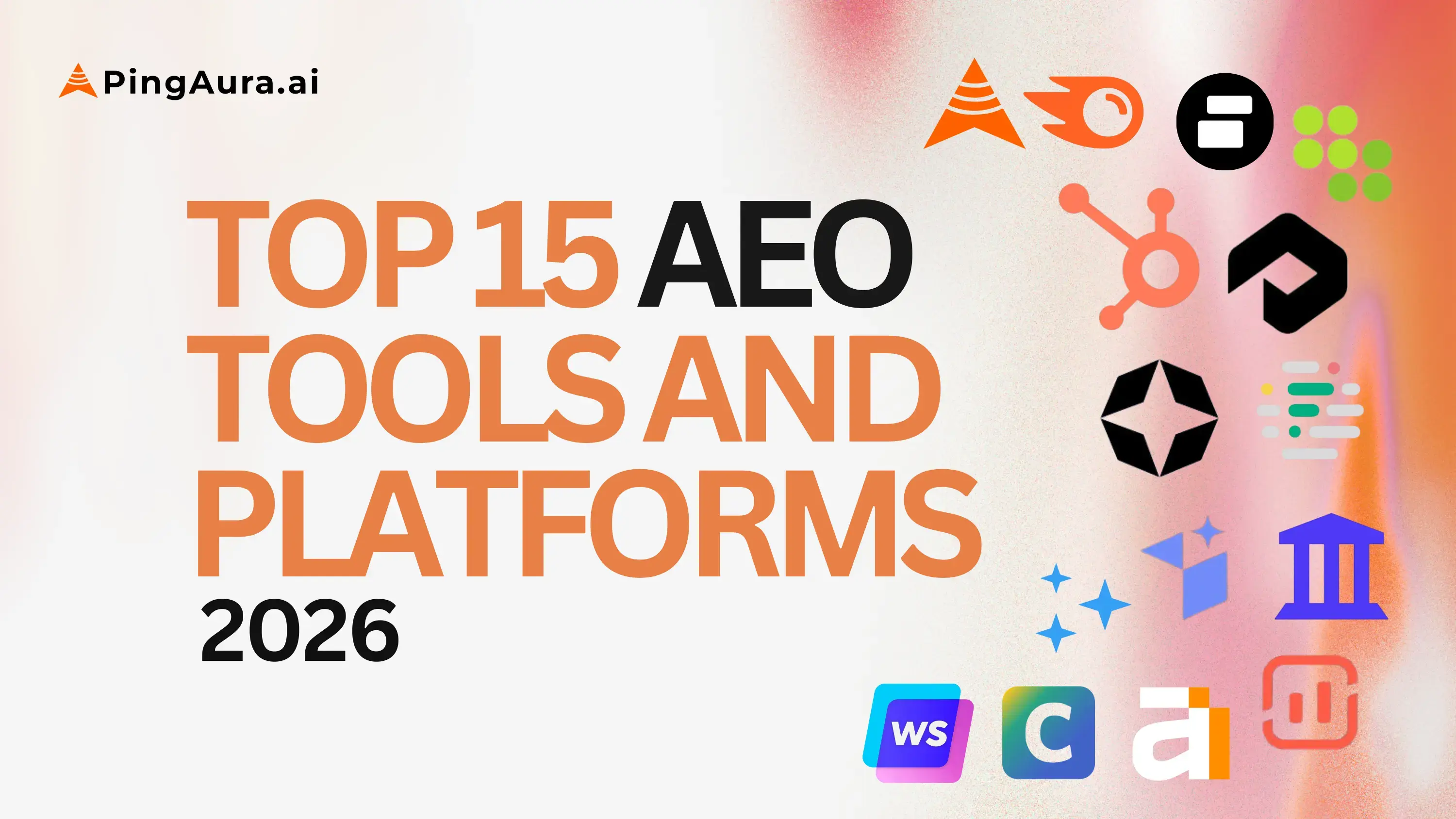
| Rank | AEO Tool | Primary Function | Best For |
|---|---|---|---|
| 1 | PingAura | Monitoring + content execution | Teams needing AI visibility tracking and workflows |
| 2 | Semrush | Brand representation analytics | Teams using it for SEO alongside AI tracking |
| 3 | Profound | Enterprise AEO analytics | Large-scale query tracking |
| 4 | Scrunch AI | Competitive benchmarking | Mid-market rival SOV analysis |
| 5 | Surfer SEO | AI-assisted structure | SEO teams refining content for LLMs |
| 6 | Conductor | Enterprise SEO + AEO | Unified search metrics dashboards |
| 7 | Athena HQ | AI visibility tracking | AI-first brand discovery |
| 8 | Peec AI | Citation tracking | Focused mention monitoring |
| 9 | Goodie AI | Schema and technical structure | Technical site audits for AI parsers |
| 10 | Writesonic | AI content drafting | Structured content generation |
| 11 | HubSpot AEO Grader | Free visibility snapshot | Quick AI presence checks |
| 12 | Frase | Intent and question mapping | Answering high-intent AI queries |
| 13 | Clearscope | Content depth optimisation | Topical coverage for expertise |
| 14 | MarketMuse | Topic authority planning | Long-term topical clusters |
| 15 | Ahrefs | SEO to AEO expansion | Existing users adding AI signals |
Best Tools for AEO Execution
1. PingAura.ai
Core capability: AI visibility tracking with integrated content execution workflows.
PingAura functions as a full-stack AEO platform, not just an analytics layer. It combines visibility measurement, attribution, and execution in one system. Beyond tracking citations and share of voice, it enables teams to act on insights directly, closing the loop between detection and optimisation.
Key strengths include:
- AI visibility monitoring across multiple LLMs
- Attribution layer via integrations (GSC, GA4, Cloudflare, Bing Webmaster Tools)
- Site health diagnostics tailored for AI parsers
- Content optimisation workflows aligned with agentic discovery and commerce
This makes it particularly valuable for teams and enterprises that want both insight and execution in a single platform, rather than stitching together multiple tools.
2. Semrush
Core capability: Brand representation analytics across search and AI ecosystems.
Semrush extends its traditional SEO dominance into AEO by introducing LLM visibility tracking and sentiment analysis. It allows teams to understand how their brand appears in AI-generated answers while maintaining strong SEO capabilities.
Key strengths:
- Unified SEO and AEO workflow
- Brand sentiment tracking in AI outputs
- Keyword and entity overlap insights
- Competitive positioning across both SERPs and AI responses
Best suited for teams already embedded in the Semrush ecosystem who want to layer AEO onto existing SEO strategies.
3. Profound
Core capability: Enterprise-scale AEO analytics and prompt tracking.
Profound is designed for organisations operating at scale, analysing massive prompt datasets across geographies and models. It focuses on identifying patterns in how AI systems respond to queries over time.
Key strengths:
- Large-scale query and prompt monitoring
- Trend detection across AI systems
- Enterprise-grade dashboards and reporting
- Cross-market visibility analysis
Ideal for enterprises needing macro-level visibility and strategic insights rather than hands-on optimisation workflows.
4. Scrunch AI
Core capability: Competitive benchmarking and share-of-voice analysis.
Scrunch AI specialises in understanding how your brand performs relative to competitors in AI-generated answers. It focuses less on content creation and more on market positioning within AI ecosystems.
Key strengths:
- Competitor SOV tracking
- Category-level benchmarking
- Gap analysis for AI visibility
- Clear comparative dashboards
Best for mid-market teams that want to quickly understand where they stand versus competitors.
5. Surfer SEO
Core capability: AI-assisted content structuring and optimisation.
Surfer SEO adapts well to AEO by helping teams structure content in a way that improves extractability by LLMs. Its editor guides content toward optimal heading hierarchy, keyword distribution, and readability.
Key strengths:
- Real-time content scoring
- Structure optimisation for AI parsing
- SERP and AI hybrid optimisation
- Actionable writing recommendations
Useful for content teams actively rewriting or creating pages to increase citation likelihood.
6. Conductor
Core capability: Unified SEO and AEO performance dashboards.
Conductor provides a centralised platform that blends traditional search metrics with emerging AI visibility signals. It is particularly strong in enterprise environments where multiple teams need a single source of truth.
Key strengths:
- Integrated reporting across channels
- Enterprise collaboration features
- SERP and AI performance tracking
- Content performance insights at scale
Best for organisations prioritising alignment across SEO, content, and analytics teams.
7. Athena HQ
Core capability: AI-native visibility tracking across LLMs.
Athena HQ is built specifically for the AI search landscape, focusing on how brands are discovered and referenced by LLMs rather than traditional search engines.
Key strengths:
- AI-first tracking architecture
- Citation monitoring across models
- Early-stage visibility diagnostics
- Discovery-focused insights
Ideal for teams looking to establish a baseline understanding of their AI presence.
8. Peec AI
Core capability: Focused citation and mention tracking.
Peec AI strips AEO down to its core signal: whether and where your brand is cited. It avoids complexity and delivers clean, actionable visibility data.
Key strengths:
- Simple citation tracking
- Lightweight dashboards
- Fast setup and interpretation
- Low operational overhead
Best for teams that want quick, focused insights without heavy tooling.
9. Goodie AI
Core capability: Technical optimisation via schema and structured data.
Goodie AI operates at the infrastructure layer, ensuring that websites are machine-readable for AI systems. It focuses on schema markup, structured content, and crawlability.
Key strengths:
- Schema audits and recommendations
- Technical SEO for AI parsers
- Content structuring validation
- Backend optimisation insights
Critical for teams that need to fix foundational issues affecting AI extractability.
10. Writesonic
Core capability: AI-driven content generation for structured outputs.
Writesonic helps generate LLM-friendly content at scale, focusing on formats that improve answer extraction, such as summaries, FAQs, and listicles.
Key strengths:
- Fast content generation
- Structured output formats
- Template-driven workflows
- Scalable content production
Useful for teams producing large volumes of structured, AI-readable content.
11. HubSpot AEO Grader
Core capability: Free snapshot of AI visibility and sentiment.
HubSpot's AEO Grader provides a quick diagnostic layer, helping teams understand how their brand appears in AI systems without deep setup.
Key strengths:
- Ease of use
- Instant visibility insights
- Entry-level benchmarking
- No-cost access
Best for teams starting out with AEO and needing a baseline assessment.
12. Frase
Core capability: Intent mapping and question-based optimisation.
Frase focuses on aligning content with user intent, particularly through questions that AI systems frequently answer.
Key strengths:
- Question clustering
- Header optimisation
- Content brief generation
- SERP-informed structuring
Effective for capturing high-intent, answer-driven queries.
13. Clearscope
Core capability: Content depth and topical completeness optimisation.
Clearscope ensures content demonstrates expertise and authority, which increases the likelihood of being trusted and cited by AI systems.
Key strengths:
- Content grading
- Semantic coverage analysis
- Topic completeness scoring
- Editorial guidance
Best for improving the quality and depth signals in existing content.
14. MarketMuse
Core capability: Long-term topical authority and content planning.
MarketMuse takes a strategic approach, helping teams build topic clusters and authority over time, which strengthens AI trust signals.
Key strengths:
- Topic gap analysis
- Content planning tools
- Authority scoring
- Strategic recommendations
Ideal for teams investing in sustained AEO growth rather than short-term wins.
15. Ahrefs
Core capability: Extending SEO data into AI-driven contexts.
Ahrefs integrates AEO signals into its established SEO toolkit, enabling users to transition into AI optimisation without changing platforms.
Key strengths:
- Strong backlink and keyword data
- Emerging AI visibility features
- Familiar interface for SEO teams
- Incremental AEO adoption
Best suited for existing Ahrefs users expanding into AI search without a full tool switch.
Execute Your AEO Strategy
In AI search, visibility is increasingly driven by trusted citations rather than rankings.
PingAura.ai is a platform that tracks AI visibility, share of voice, and citations while enabling execution. It helps teams generate AEO-friendly content, audit site health, prepare for agentic commerce, measure AI-driven traffic through integrations, and optimise content to secure AI presence.