TL;DR
AI traffic is website traffic originating from AI platforms such as ChatGPT, Gemini, Claude, and Perplexity. As more people use AI assistants to research products, services, and brands, AI traffic is becoming a major customer acquisition channel. Tracking AI traffic helps businesses understand which AI platforms drive visitors, how those visitors behave on-site, and whether they convert into leads or customers.
What Changed in Search?
For more than two decades, search was built around keywords, rankings, and blue links. Users entered a query into a search engine, reviewed multiple results, clicked through to websites, and gathered information themselves.
Today, that behaviour is changing. AI assistants can answer questions directly, compare products, summarise content, and recommend brands without requiring users to browse multiple websites. Instead of searching for information, users are increasingly having conversations with AI systems.
This shift has fundamentally changed how brands are discovered online. Traditional SEO focused on ranking in search results. AI optimisation focuses on becoming a trusted source that AI systems cite, reference, and recommend in their answers.
As AI adoption accelerates, visibility in AI-generated responses is becoming just as important as visibility in traditional search engines. Businesses that understand how AI systems discover, evaluate, and surface content will be better positioned to capture future demand.
What Is AI Traffic?
AI traffic refers to visitors who arrive on your website after interacting with an AI platform. These visits typically originate from AI-generated recommendations, citations, source links, or conversational search experiences.
For example, a user may ask ChatGPT, Gemini, or Perplexity for the best project management software, cybersecurity platform, or AI SEO solution. If the AI assistant recommends your company and the user clicks through to your website, that visit is considered AI traffic.
Unlike traditional search traffic, AI traffic originates from conversations rather than keyword searches. As AI becomes a preferred way to discover information, AI traffic is emerging as a new acquisition channel alongside organic search, paid advertising, social media, and email marketing.
Human Traffic vs. Agent Traffic
The rise of AI has introduced a new category of website interaction: agent traffic.
Human Traffic
Human traffic consists of real people visiting your website through search engines, social media platforms, advertisements, referrals, email campaigns, or direct navigation. These visitors read content, compare products, fill out forms, book demos, and make purchases.
Most marketing and analytics systems have traditionally focused on understanding and optimising human traffic.
Agent Traffic
Agent traffic consists of AI systems, retrieval agents, crawlers, and autonomous assistants that access and process website content on behalf of users. These systems analyse content, compare sources, evaluate brands, and generate answers before a human visitor ever reaches a website.
For example, when a user asks an AI assistant for software recommendations, the AI agent may review dozens of sources and websites before presenting a shortlist of suggested solutions.
Why the Difference Matters
The customer journey is no longer limited to human interactions. AI agents increasingly influence discovery, research, and decision-making before users visit a website.
This means businesses now need to optimise for two audiences:
- Humans who visit and convert
- AI agents that discover, interpret, and recommend content
A company may have strong website traffic but poor AI visibility, causing it to be excluded from AI-generated recommendations. Alternatively, it may be frequently cited by AI systems but lacks the attribution needed to measure business impact.
Understanding both human and agent traffic provides a more complete picture of modern customer acquisition.
Why Is AI Traffic Important?
AI is rapidly becoming a primary discovery channel. Instead of reviewing multiple search results, users increasingly rely on AI-generated answers to find products, services, and information.
This change matters because AI traffic is often high intent. Users typically engage with AI assistants when they are actively researching solutions, comparing vendors, or evaluating purchases. As a result, AI visitors often arrive with a clearer understanding of their needs and may be more likely to convert.
For businesses, AI traffic represents an opportunity to understand how AI platforms influence brand awareness, website engagement, lead generation, and revenue.
Why Should Businesses Track AI Traffic?
As AI becomes a larger part of the customer journey, businesses need visibility into how AI-driven discovery impacts performance.
Tracking AI traffic helps answer important questions such as:
- Which AI platforms generate the most traffic?
- Which pages attract AI visitors?
- How engaged are AI visitors compared to other channels?
- Which AI recommendations drive conversions?
- How much revenue can be attributed to AI-driven discovery?
Without proper attribution, many AI-generated visits may be classified incorrectly or missed entirely. This makes it difficult to measure ROI and understand the true value of AI optimisation efforts.
How to Track AI Traffic
No single analytics platform can accurately measure AI traffic today. Businesses need to combine analytics, search performance, crawler data, and attribution signals to understand how AI influences website visits and conversions.
Google Analytics 4 (GA4)
GA4 provides visibility into sessions, engagement metrics, and conversion events. While it can track some AI-driven visitors, it often lacks complete attribution for AI-generated traffic because many AI platforms do not consistently pass referral information.
As a result, a significant portion of AI traffic may appear as direct traffic or be grouped into other channels, making it difficult to understand the true impact of AI-driven discovery using GA4 alone.
Google Search Console
Google Search Console provides insights into search visibility, indexing, and content performance. It helps businesses understand how traditional search performance and AI visibility work together, particularly as AI platforms increasingly rely on publicly available web content.
Cloudflare
Cloudflare offers server-side visibility into crawler activity and bot patterns, which can help identify AI agent access to your website. This data provides an additional layer of insight into how AI systems discover, retrieve, and process your content before it is surfaced in AI-generated responses.
Bing Webmaster Tools
As Microsoft's AI ecosystem continues to expand through Copilot and Bing, Bing Webmaster Tools provides valuable visibility into search performance and discovery patterns across Microsoft's search and AI infrastructure.
A Better Way to Track AI Traffic
While each platform provides useful insights, manually combining data from multiple systems is complex and often incomplete.
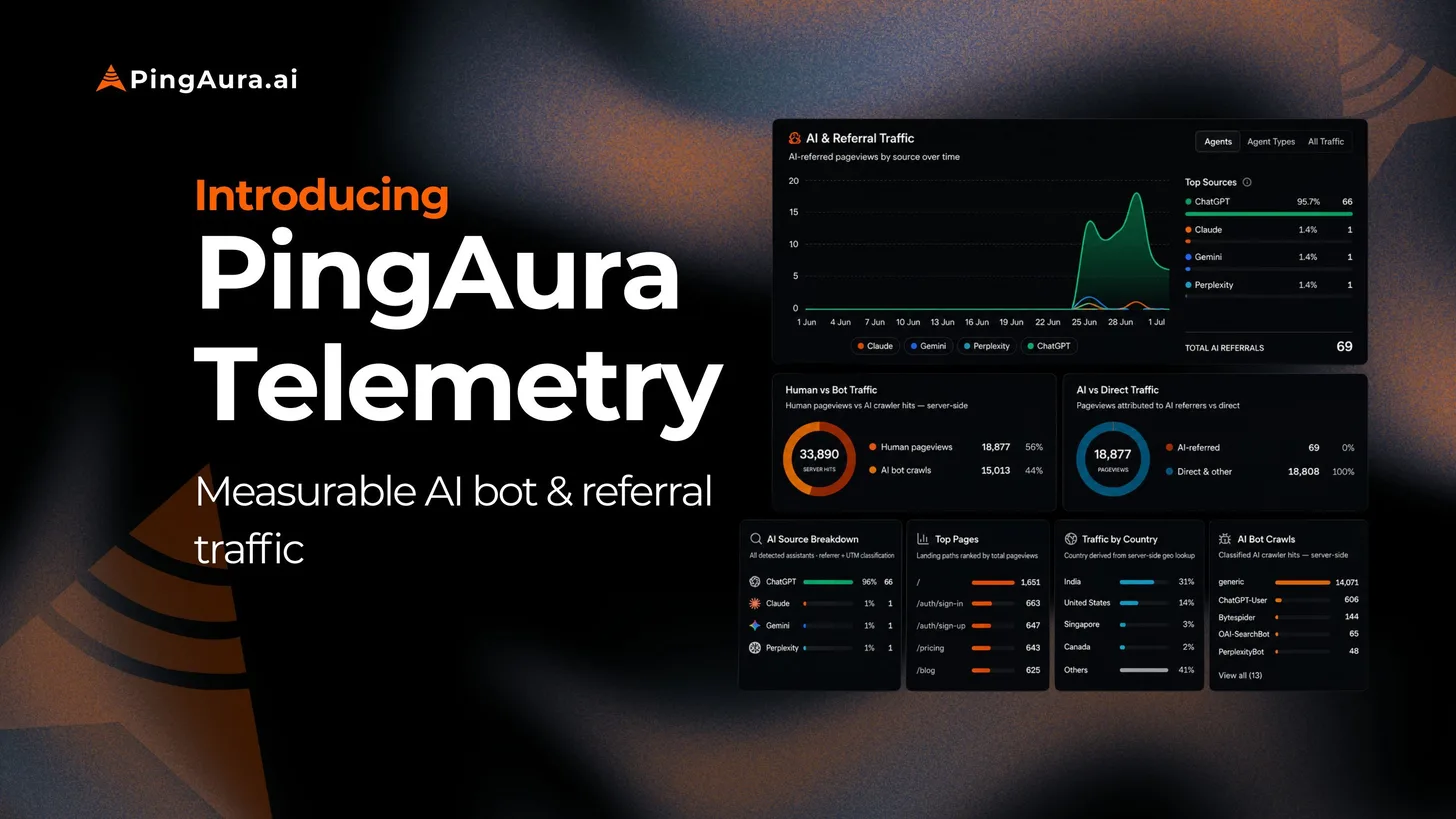
PingAura's Site Health Agent integrates directly with Google Analytics 4 (GA4), Google Search Console, Cloudflare, and Bing Webmaster Tools to provide a unified view of AI traffic and AI visibility.
By combining website analytics, search performance data, crawler intelligence, referral patterns, and AI visibility signals, PingAura helps businesses understand how AI platforms influence website visits, engagement, conversions, and revenue.
Instead of relying on assumptions, teams gain visibility into the complete AI customer journey, from AI discovery and brand mentions to website visits and business outcomes.
Why AI Traffic Attribution Matters
Measuring AI traffic is only the first step. The real challenge is attribution.
A visitor may first discover your brand through ChatGPT, continue their research through Google, revisit your website later, and convert weeks afterwards. Traditional attribution models often fail to capture the influence of AI during this journey.
AI traffic attribution helps businesses understand not just where visitors came from, but how AI platforms contributed to awareness, consideration, and conversion. This creates a clearer picture of marketing performance and allows teams to invest more confidently in AI optimisation initiatives.
Start Tracking AI Traffic with PingAura
Understanding what AI traffic is remains vital for growth. In 2026, specialised attribution is no longer optional for businesses. Traditional analytics suites often miss critical LLM referral traffic paths. You need precise data to optimise your digital ROI effectively.
PingAura attributes AI-driven traffic by connecting directly with your existing analytics and search data sources, including Google Analytics 4 (GA4), Google Search Console (GSC), Cloudflare, and Bing Webmaster Tools.
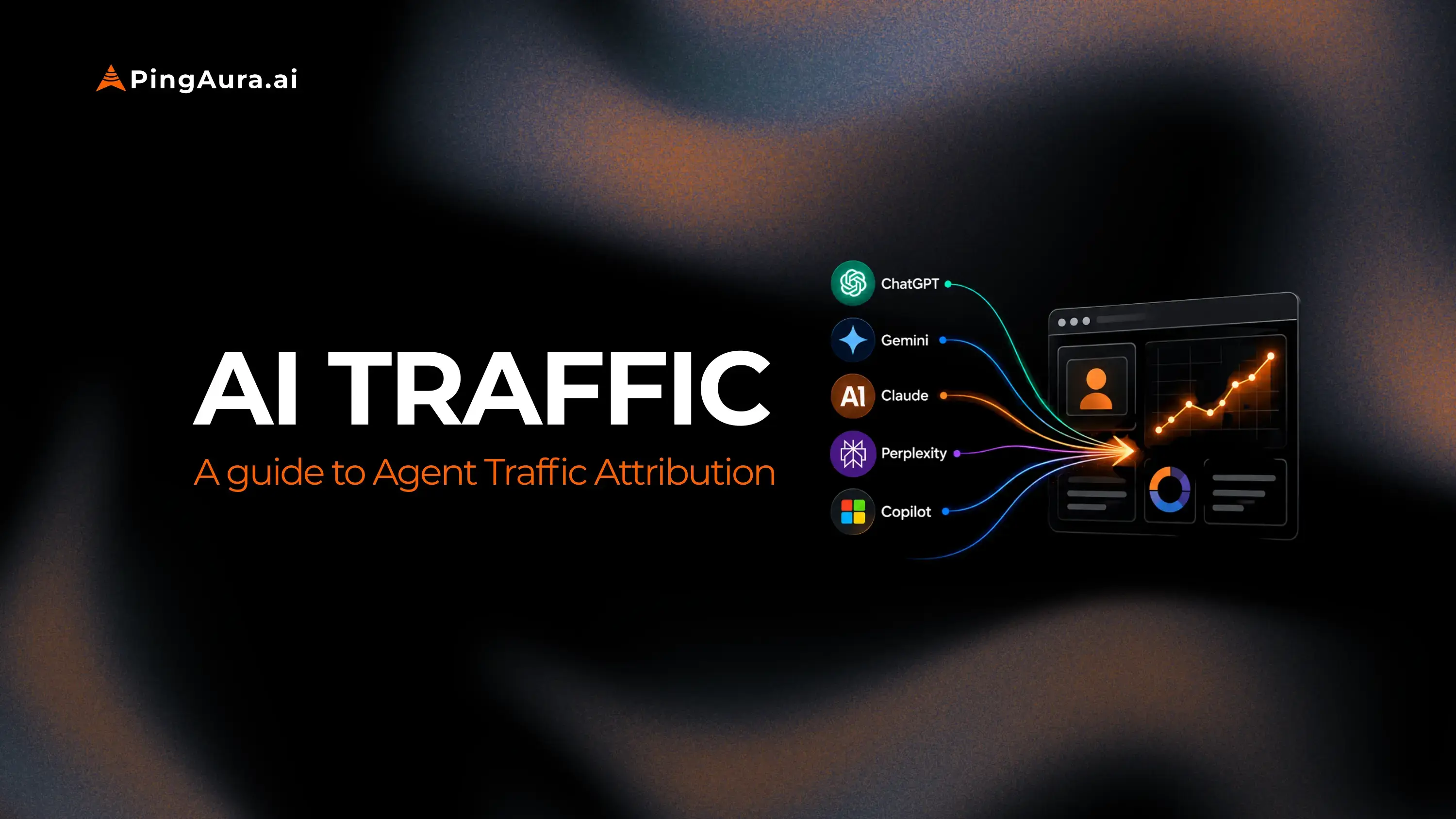
Once integrated with PingAura's Site Health Agent, the platform analyses traffic, referral patterns, server logs, search performance, and user behaviour to identify visitors arriving from AI platforms such as ChatGPT, Gemini, Claude, Perplexity, and other AI assistants. By combining data across these systems, PingAura uncovers AI-driven sessions that traditional analytics tools often misclassify or fail to attribute accurately.
Hence, PingAura helps you not just optimise for AI but also see real-time outcomes of your optimisation efforts, and further guide you towards what to work on.
Sign up at PingAura.ai today to build your new distribution channel inside AI, and let's monetise AI together.
FAQs
What is AI traffic?
AI traffic refers to website visitors who arrive through AI-generated recommendations, citations, or links from platforms such as ChatGPT, Gemini, Claude, Perplexity, and Copilot.
Is AI traffic the same as organic traffic?
No. Organic traffic comes from traditional search engine results, while AI traffic originates from AI-powered search and conversational experiences.
What is agent traffic?
Agent traffic refers to visits or interactions generated by AI systems, crawlers, retrieval agents, and autonomous assistants that access and process content on behalf of users.
Why is AI traffic important?
AI traffic represents a growing source of high-intent visitors and provides insight into how AI platforms influence brand discovery, engagement, and conversions.
Can Google Analytics track AI traffic?
GA4 can identify some AI-related traffic, but it often lacks the attribution capabilities required to fully understand AI-driven customer journeys and business outcomes.
How does PingAura track AI traffic?
PingAura integrates with GA4, GSC, Cloudflare, and Bing Webmaster Tools to identify AI-driven visitors, analyse user behaviour, monitor AI visibility, and connect AI discovery to conversions and revenue.
Conclusion
The way people discover information online is changing. AI assistants are increasingly becoming the first point of contact between customers and brands, creating a new category of traffic that traditional analytics systems were not designed to measure.
Organisations that understand both human traffic and agent-driven discovery will be better positioned to compete in the next era of search. By tracking AI traffic, measuring AI visibility, and attributing business outcomes to AI-driven interactions, businesses can gain a clearer understanding of how AI influences growth and customer acquisition.
The future of search is no longer just about rankings. It is about being discovered, trusted, and recommended by AI systems, and having the data to prove the impact.