TL;DR
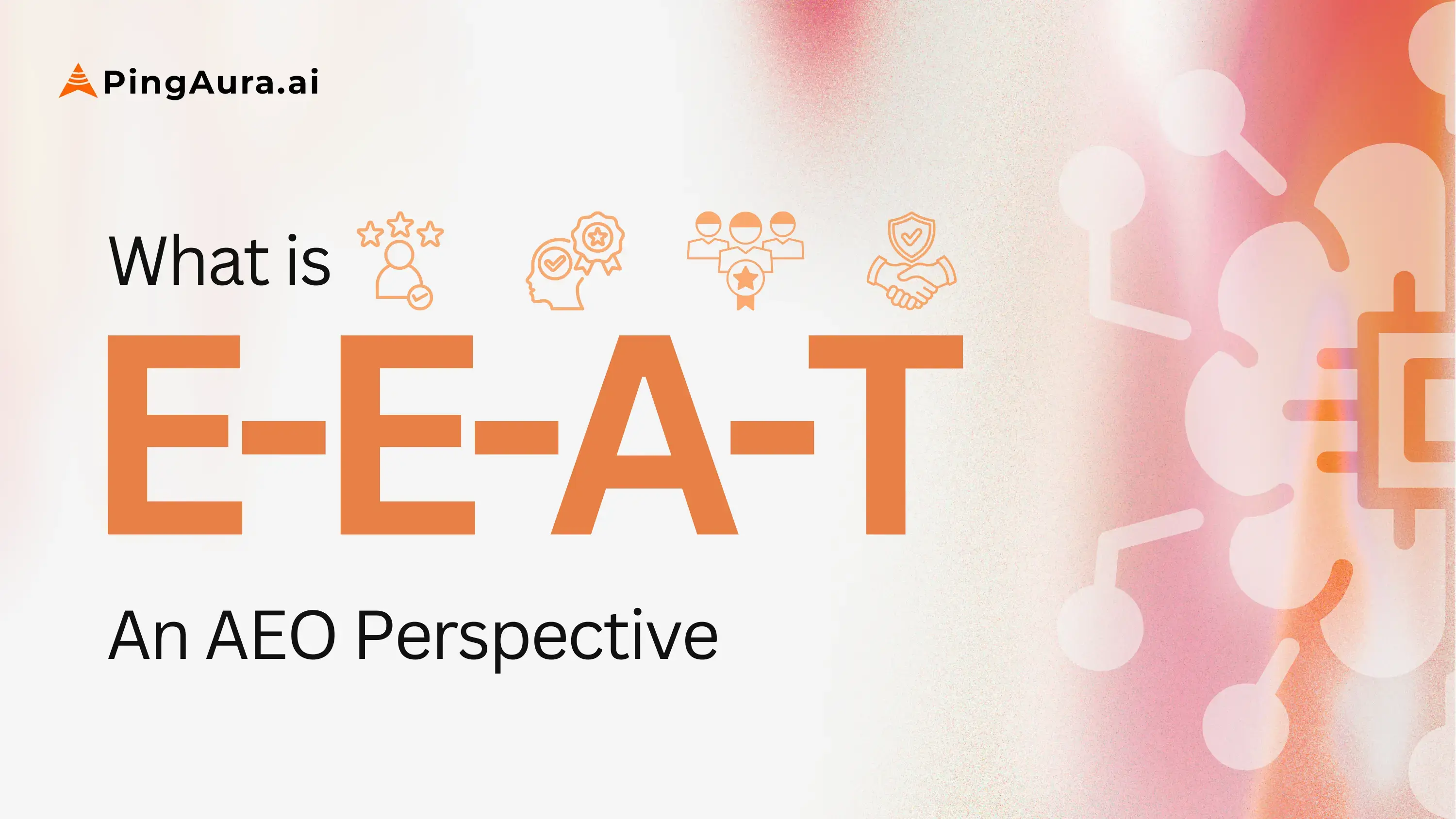
- E-E-A-T = Experience, Expertise, Authoritativeness, Trustworthiness
- In SEO, it influences how search systems assess content quality and relevance
- In AEO, stronger trust and credibility signals can improve the chances of being selected as a source
- AI search raises the bar for trust and credibility
- E-E-A-T analysers help make these signals measurable and actionable
Use PingAura's free E-E-A-T checker if you want to check a live page for authorship, citation, structured data, and transparency signals before editing.
Introduction
Search has evolved.
What started as keyword matching has increasingly become answer selection.
At the center of this shift is one concept that has remained consistent but is now more critical than ever: E-E-A-T.
This guide explains E-E-A-T in two contexts:
- How it works in traditional SEO
- How it operates in AI-driven answer engines (AEO)
What Is E-E-A-T?
E-E-A-T stands for:
- Experience
- Expertise
- Authoritativeness
- Trustworthiness
It is a framework defined in Google's Search Quality Rater Guidelines to evaluate content quality.
E-E-A-T is not a direct ranking factor, but it is a model Google uses in quality evaluation to define what trustworthy, high-quality content looks like.
E-E-A-T in SEO: A Foundational Understanding
This is where most people first encounter E-E-A-T.
In traditional search engines, E-E-A-T helps explain one core question:
Which pages deserve to rank higher?
How E-E-A-T Works in SEO
Search engines evaluate multiple signals that align with E-E-A-T, including:
- Content depth and accuracy
- Backlinks and mentions
- Author credibility
- Website trust signals
These signals can collectively influence how content performs in search.
The Role of the 4 Pillars in SEO
Experience
- First-hand usage improves authenticity
- Especially important for reviews and comparisons
Expertise
- Demonstrated knowledge increases content quality
- Credentials matter more in technical fields
Authoritativeness
- Built through backlinks, mentions, and brand recognition
Trustworthiness
- The most important pillar
- Includes accuracy, transparency, and reliability
Where SEO E-E-A-T Falls Short
Traditional SEO can still allow:
- Content to rank based on backlinks, even if it is shallow
- Pages to compete using keyword optimisation alone
- Visibility without true credibility in some cases
This is becoming harder as search systems get better at evaluating quality and trust.
E-E-A-T in AEO (Answer Engine Optimisation)
In AI search, E-E-A-T is no longer just a useful SEO lens.
In practice, it acts more like a selection lens for whether a source feels dependable enough to reuse in generated answers.
AI systems often do more than rank pages in a list. They may:
- Select sources
- Extract information
- Generate answers
If your content appears weak, unclear, or untrustworthy, it is less likely to be selected.
How E-E-A-T Works in AI Search
AI systems generally prioritise:
- High-confidence sources
- Verifiable information
- Strong entity and brand signals
- Clear authorship and expertise
This creates a stricter environment than traditional SEO for content that wants to be cited, summarised, or reused.
Key Shift: From Ranking Support to Selection Criteria
In SEO:
- Content with weaker E-E-A-T can still rank if other signals are strong
In AEO:
- Weak E-E-A-T can reduce the chance of being cited or reused in generated answers
This is the core shift.
What Each Pillar Means in AEO
Experience in AEO
- First-hand insights increase uniqueness
- Systems are more likely to value content that is not easily replicable
Expertise in AEO
- Content must demonstrate clear subject mastery
- Surface-level summaries are less differentiated and therefore easier to overlook
Authoritativeness in AEO
- Clear entity recognition and topic association become more important
- Brands and authors must be consistently associated with topics
Trustworthiness in AEO
- Becomes a major gating factor
- Systems are less likely to rely on uncertain or weakly sourced content
Why E-E-A-T Is More Important in AI Than SEO
E-E-A-T becomes more visible in AEO than in SEO because AI systems:
- depend on trustworthy inputs to generate answers
- work better when information is clear, attributable, and verifiable
- need confidence in sources before reusing them in summaries or responses
This raises the bar significantly.
The Measurement Problem Becomes Critical
In SEO, you could attribute success through:
- Rankings
- Traffic
- Backlinks
In AI search, those signals are less visible.
You now need to answer questions like:
- Why is my content not being selected or cited?
- Where is trust breaking down?
- What signals am I missing?
The Role of an E-E-A-T Analyser in AEO
This is where structured analysis becomes especially useful.
An E-E-A-T analyser helps translate hard-to-see signals into clear diagnostics.
What it evaluates
- Presence of experience signals
- Depth of expertise
- Authority indicators
- Trust and transparency factors
Why It Matters in AEO
Without analysis:
- You are guessing
- You cannot see why the content is ignored
- You cannot prioritise improvements
With analysis:
- You identify credibility gaps
- You understand selection barriers
- You improve the probability that your content will be considered for inclusion in AI answers
FAQs
Is E-E-A-T more important for AI search than SEO?
Generally, yes. In AI search, trust and source quality appear closer to selection criteria than to a simple supporting quality signal.
Can content rank in SEO but fail in AI search?
Yes. Content with weak trust or shallow depth may still rank in traditional search but be less likely to be selected by AI systems.
What is the biggest change in AEO?
The shift from ranking to selection. Visibility increasingly depends on being trusted enough to be used as a source.
How do I optimise for E-E-A-T in AI search?
Focus on:
- Original experience
- Deep expertise
- Strong brand signals
- Clear trust indicators
Do I need a tool to improve E-E-A-T?
While not mandatory, tools like PingAura's E-E-A-T Analyser can significantly reduce guesswork and improve execution speed.
Conclusion
E-E-A-T is no longer just a soft guideline you can loosely optimise for. It is a practical quality framework for understanding whether your content looks credible enough to compete in modern search experiences.
In traditional SEO, you could compete with tactics.
In AI search, you compete more directly on credibility, clarity, and confidence signals.
That changes how content needs to be created:
- You are unlikely to fake experience convincingly
- You are unlikely to shortcut expertise in a durable way
- You cannot manufacture trust overnight
What you can do is systematically build and validate these signals.
That is the real shift: from optimising content only for ranking to improving it for selection and trustworthiness.
The brands that are more likely to win in this new paradigm are not necessarily the ones that publish the most content, but the ones that can consistently produce content that people and systems trust enough to use.
Ready to Improve Your E-E-A-T?
Optimise your brand's online presence and get selected in AI search by signing up with PingAura.ai, and strengthen your E-E-A-T signals today.
PingAura: Monetise AI