AI visibility matters because health insurance buyers now lean on AI answers to weigh up policies before they ever visit an insurer's website.
When someone asks about family plans, waiting periods, or pre-existing disease cover, AI tools sum up the options for them. If your brand is left out of that summary, you may not make their shortlist.
AI search has become an early filter on who gets considered.
How Are Customers Using AI for Health Insurance Research?
Customers ask very specific, ready-to-buy questions like:
- Which health insurance plan is best for families?
- What is the waiting period for pre-existing diseases?
- Which insurer offers cashless hospitalisation?
- Is a top-up plan better than raising my base cover?
AI tools answer by:
- Explaining the types of policy
- Comparing insurers
- Clarifying what is not covered
- Summarising how claims work
These answers build trust and shape the shortlist before anyone visits a website.
What Makes Health Insurance Especially Sensitive in AI Search?
Health policies have tricky details that must be explained correctly:
- Waiting periods
- Co-pay clauses
- Sub-limits
- Network hospitals
- Exclusions
- Restoration benefits
If an AI summary oversimplifies or gets these wrong, customers end up with the wrong expectations. That makes clear, consistent policy documents essential.
How Is AI Search Different from Traditional SEO?
Traditional SEO chases keyword rankings like "best health insurance plan" or "family premium."
AI search works in a different order: a question, then a single written answer, then maybe a website visit.
There is no ranked list. The AI picks which insurers to name and how to describe them.
So health insurers now have to optimise for being included and described well, not just for traffic. This is where Answer Engine Optimisation comes in.
Why Is Your Health Insurance Brand Missing from AI Answers?
It usually comes down to gaps in how your information is set up:
- Unclear coverage: If benefits and exclusions are not clearly separated, AI tools struggle to pull the facts.
- Inconsistent terms: Different names for the same feature create confusion.
- No clear comparison: If you do not spell out what sets your plan apart, AI tools may favour clearer rivals.
AI tools reward clarity, consistency, and well-structured information.
What Metrics Define AI Visibility for Health Insurance?
Health insurers should track AI signals, not just search traffic. The key metrics are:
- Inclusion rate: How often do you show up in high-intent health insurance questions?
- Feature association: Are your policies linked to terms like low waiting period or large hospital network?
- Accuracy: Do AI summaries get your policy terms right?
- Comparative frequency: How often do you appear in insurer-versus-insurer questions?
- Stability: Does your brand show up consistently across different AI tools?
Together, these give a clear view of your AI presence.
What Role Does the IRDAI Play?
In India, the Insurance Regulatory and Development Authority of India (IRDAI) oversees transparency and policyholder protection.
AI-driven discovery raises a few compliance points:
- Exclusions must be shown accurately
- Waiting periods must be communicated properly
- Co-pay rules must be disclosed clearly
- Claim settlement must be described responsibly
AI tools write their own summaries, but you are still responsible for keeping your public policy information correct and compliant. Clear, standard disclosures lower both regulatory and reputational risk.
Why Should Health Insurers Benchmark Their AI Presence?
Without benchmarking, you cannot measure AI visibility in a fair way.
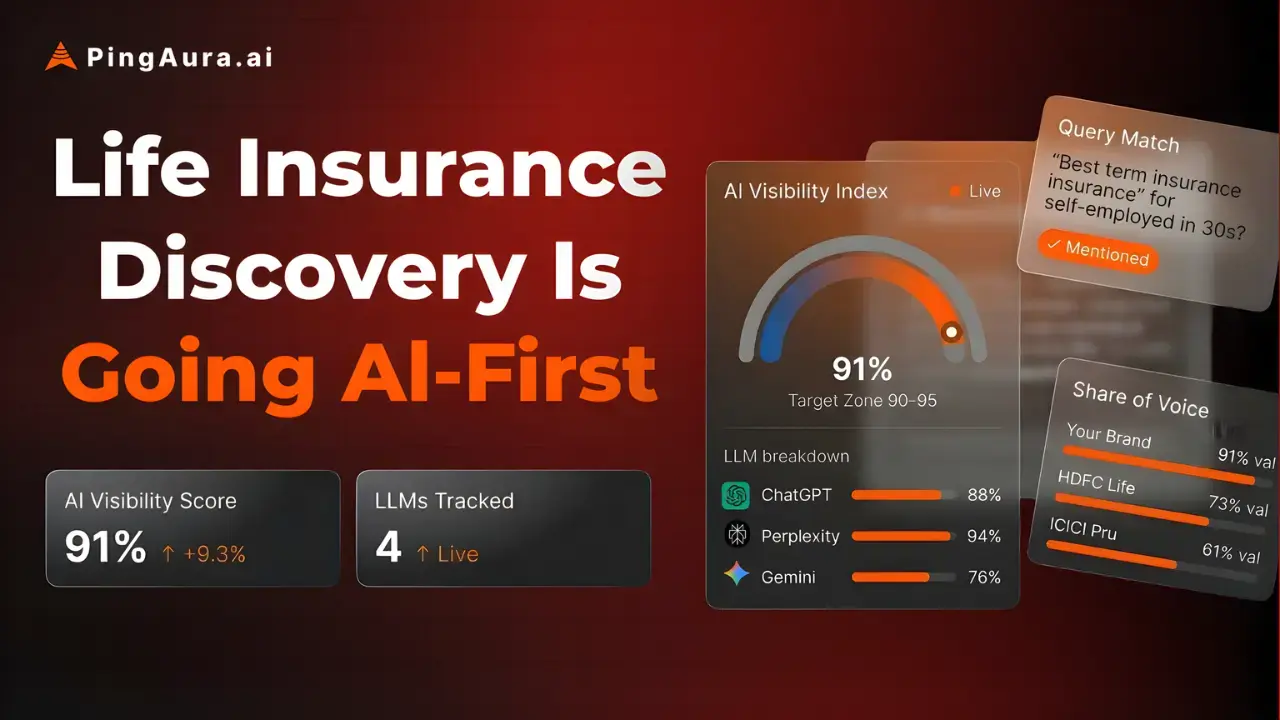
The LLM Visibility Index benchmarks how brands appear across AI tools. It helps you answer:
- Are we always included in family floater questions?
- Are rivals winning pre-existing disease queries?
- Is our coverage summarised correctly?
How Can PingAura Help Health Insurance Brands Compete in AI Search?
PingAura.ai is an AI Search and Monetisation OS that helps regulated industries manage how they show up in AI-driven discovery.
For health insurance brands, PingAura helps you:
- Measure AI visibility and share of voice against rivals
- Spot gaps in how your coverage is described
- Optimise content in line with the rules
- Link AI exposure to policy conversions
- Turn AI-influenced journeys into revenue
If AI tools shape how customers judge health insurance, you have to manage that visibility on purpose.
Visit PingAura.ai to request an AI visibility assessment and see how your health insurance portfolio shows up inside AI policy comparisons.
Conclusion
AI search is becoming the first place health insurance buyers do their research. People now rely on AI summaries to understand waiting periods, exclusions, and plan comparisons before visiting a website.
That shift changes how you compete. Success now rests on:
- Clear, well-structured policy documents
- The same terms across all your content
- Disclosures that meet the rules
- AI visibility you can measure
Health insurers who watch and improve how AI describes them will shape what customers think early on. Those who ignore it risk being left out of the conversations that matter most.
If you do not know how AI tools describe your products today, you are flying blind on a fast-growing channel.
AI is shaping health insurance discovery. The real question is whether your brand shows up clearly and accurately when customers ask for help.