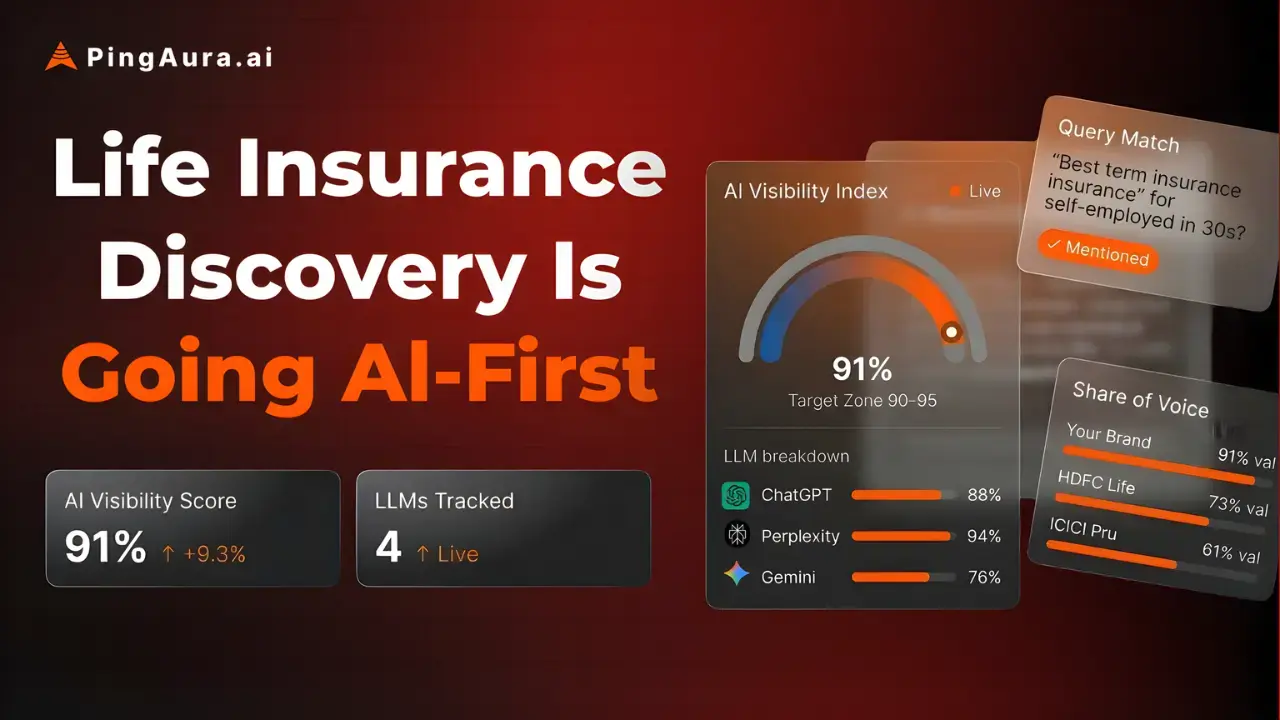
Life insurance discovery is undergoing a fundamental change. For years, insurers relied on traditional search engines where consumers typed short keywords, compared links, and clicked through to websites. AI-powered search interfaces are now disrupting that model.
Consumers are increasingly using AI models such as ChatGPT, Perplexity, and Gemini to research financial decisions. Instead of searching for single keywords, users now ask complex, conversational questions.
Examples include:
- Is term insurance worth it for someone in their 30s?
- HDFC Life vs ICICI Prudential. Which one is better for long-term coverage?
- How much life insurance cover does a self-employed person need?
These questions reflect a shift from keyword search to intent-driven discovery. For life insurance companies, where trust and consideration cycles are long, this change has significant implications.
From Keywords to Prompt Clusters in Life Insurance Search
Traditional search behavior focused on isolated keywords such as "best term insurance" or "life insurance premium". AI search works differently.
Users now ask groups of related questions within a single session. These are often referred to as prompt clusters. A prompt cluster combines education, comparison, and decision-making in one interaction.
For example, a user researching term insurance may ask about eligibility, pricing, tax benefits, and brand comparisons in one continuous conversation. The AI synthesises answers instead of presenting a list of links.
This means brands no longer compete for rankings on a results page. They compete for visibility and preference within the AI-generated answer itself.
What are the Key Problems AI Search Creates for Life Insurance Brands?
1. Brand Invisibility in AI Answers
- Insurers find that their brand does not appear in AI-generated responses, even for queries where they are relevant. This happens because AI systems rely on structured, well-defined content to understand brands as entities.
- If a brand's content is optimised only for traditional SEO, the AI may not identify it as a strong authority within a given insurance topic.
- In AI search environments, if a brand is not mentioned, it is effectively invisible during the decision-making stage.
2. Limited Control Over Brand Representation
- In traditional SEO, brands control landing pages, messaging, and service descriptions. In AI search, representation is synthesised by the model.
- The AI decides which insurers to mention, how they are described, and whether they are positioned positively or neutrally. Inaccurate or incomplete representations can occur if the brand's information is fragmented across the web.
- This creates a new challenge where brands must influence how AI systems interpret and summarise them, not just how users perceive their websites.
3. Lack of Attribution for AI-Driven Influence
- Most analytics tools were designed for click-based journeys. AI search often removes or delays the click entirely.
- A user may receive a recommendation from an AI assistant, remember the brand, and later visit the website directly. Traditional analytics cannot connect that conversion back to the AI interaction.
- As a result, marketing teams struggle to measure the impact of AI-driven discovery on leads and conversions.
Why Traditional SEO Tools Cannot Track AI Search Effectively
Traditional SEO follows a linear model. A query leads to ranked links, clicks, and measurable sessions. Tools like Google Search Console and GA4 are designed around this structure.
AI search follows a synthesis model. The AI aggregates information from multiple sources and generates a single answer. Rankings are implicit, not visible. Brand mentions may occur without a link or click.
Because brands appear as concepts within sentences rather than as URLs, traditional SEO tools cannot measure visibility, influence, or preference inside AI responses.
PingAura.ai's LLM Visibility Index tool helps you track your AI visibility score across various LLMs. This can further help you strategise and optimise your brand to boost visibility using PingAura's tools and solutions.
Metrics That Matter for AI Visibility and AEO
Since there is no page-one ranking in AI search, brands need new performance metrics. These metrics focus on how a brand appears within AI-generated answers.
Key AI visibility metrics include:
- Presence: Whether the brand is mentioned in relevant AI prompts.
- Prominence: How early and clearly the brand appears in the response.
- Preference: Whether the brand is recommended or positioned favorably compared to competitors.
- Precision: Whether factual details such as premiums, policy terms, and coverage are accurate.
- Persistence: Whether the brand appears consistently across similar prompts and platforms.
These metrics support Answer Engine Optimisation by ensuring that AI systems can accurately retrieve and present brand information.
How AI Search Changes Life Insurance Optimisation Strategy
Optimising for AI search is not about increasing keyword density. It requires clarity, structure, and consistency.
Effective AI optimisation focuses on:
- Clear brand and product definitions
- Structured explanations of policies and benefits
- Explicit comparisons with competitors
- Consistent terminology across content
- Content designed for machine understanding as well as human readers
Life insurance products are complex. AI systems favor content that explains complexity in a precise and unambiguous way.
What Is the Role of IRDAI as a Regulator in the AI Search Shift for Insurance?
As AI platforms influence insurance discovery, regulatory oversight becomes central to maintaining consumer protection and market integrity. In India, the Insurance Regulatory and Development Authority of India oversees insurance providers, product transparency, and fair selling practices.
AI-mediated discovery introduces new dimensions to these responsibilities.
How Does AI Search Affect Insurance Regulation?
Insurance products involve complex terms such as:
- Sum assured
- Riders
- Exclusions
- Waiting periods
- Claim settlement ratios
AI-generated summaries simplify this information. While simplification improves accessibility, it also increases the risk of oversimplification.
Regulatory concerns may include:
Accuracy of Product Representation
Incorrect summaries of policy exclusions or benefits can create misaligned expectations.
Fair Comparison Practices
AI-generated comparisons between insurers may influence customer perception without full context.
Mis-selling Risks
Even without human agents, AI summaries can indirectly influence purchase decisions.
Insurers remain responsible for ensuring that product information is clear, complete, and compliant.
How Does IRDAI's Mandate Extend to AI-Driven Discovery?
IRDAI's core mandate includes:
- Protecting policyholder interests
- Promoting transparency
- Ensuring fair disclosure
- Regulating product communication
As AI platforms become part of the discovery layer, insurers must ensure that structured disclosures, policy wordings, and benefit illustrations are consistently presented across digital channels.
AI systems rely on publicly available data. If that data is ambiguous, inconsistent, or promotional in tone, representation risk increases.
How Should Insurers Adapt to Remain Regulatory-Compliant?
To align with IRDAI expectations during the AI shift, insurers should:
- Maintain standardised digital policy definitions
- Clearly structure exclusions and limitations
- Synchronise product data across web properties
- Periodically audit how AI systems summarise policies
- Embed compliance review into AI optimisation initiatives
AI discovery does not replace regulatory obligations. It expands the surface area where clarity and consumer protection must be enforced.
For insurance leaders, an AI visibility strategy must balance growth objectives with strict disclosure discipline.
How PingAura Supports AI Search and Monetisation
PingAura is designed to help brands adapt to AI-driven discovery by addressing the full funnel from visibility to conversion.
The platform operates across four core layers:
- AI Visibility and Diagnostics: Analyses how a brand is represented across AI platforms and identifies gaps versus competitors.
- AI Optimisation: Structure content and knowledge layers so AI systems can correctly interpret and prioritise the brand.
- AI Attribution: Connects AI-driven discovery to downstream traffic and conversions, even when clicks are indirect.
- AI Ads and Agentic Commerce: Enables sponsored placements and transactional flows within AI-driven environments, including zero-click interactions.
This approach allows life insurance brands to move beyond rankings and focus on measurable influence inside AI conversations.
The Future of Life Insurance Discovery
Life insurance marketing is shifting from ranking on search engines to being selected within AI-generated answers.
Consumers increasingly rely on AI systems to summarise options, compare providers, and guide decisions. Brands that are not visible or accurately represented in these systems risk being excluded from consideration entirely.
The future of discovery is not about traffic alone. It is about relevance, trust, and clarity within AI-mediated conversations.
For insurers, the key question is no longer where you rank. It is whether the AI includes you, understands you, and recommends you.
FAQs
What is the difference between SEO and AEO?
SEO focuses on optimising webpages to rank and earn clicks. AEO focuses on ensuring accurate inclusion and representation within AI-generated answers.
Why does my brand not appear in AI search results?
Brands are often missing because their content lacks structured definitions and clear entity signals that AI systems rely on.
Can AI-driven traffic be measured?
Yes. With specialised attribution frameworks, brands can measure assisted conversions and behavioral signals influenced by AI platforms.
Ready to Make Your Brand Visible Inside AI?
If your insurance brand is not appearing consistently in ChatGPT, Gemini, or Perplexity responses, you are already losing share of voice inside AI-driven discovery.
PingAura.ai is an AI Search and Monetisation OS built to help insurance marketers:
- Measure AI Visibility and Share of Voice
- Optimise brand representation inside LLM answers
- Track AI-driven attribution and assisted conversions
- Activate monetisation opportunities within the AI environments
Do not wait for AI platforms to define your brand narrative.
Visit PingAura.ai to request an AI Visibility audit and understand how your brand performs inside AI conversations today.