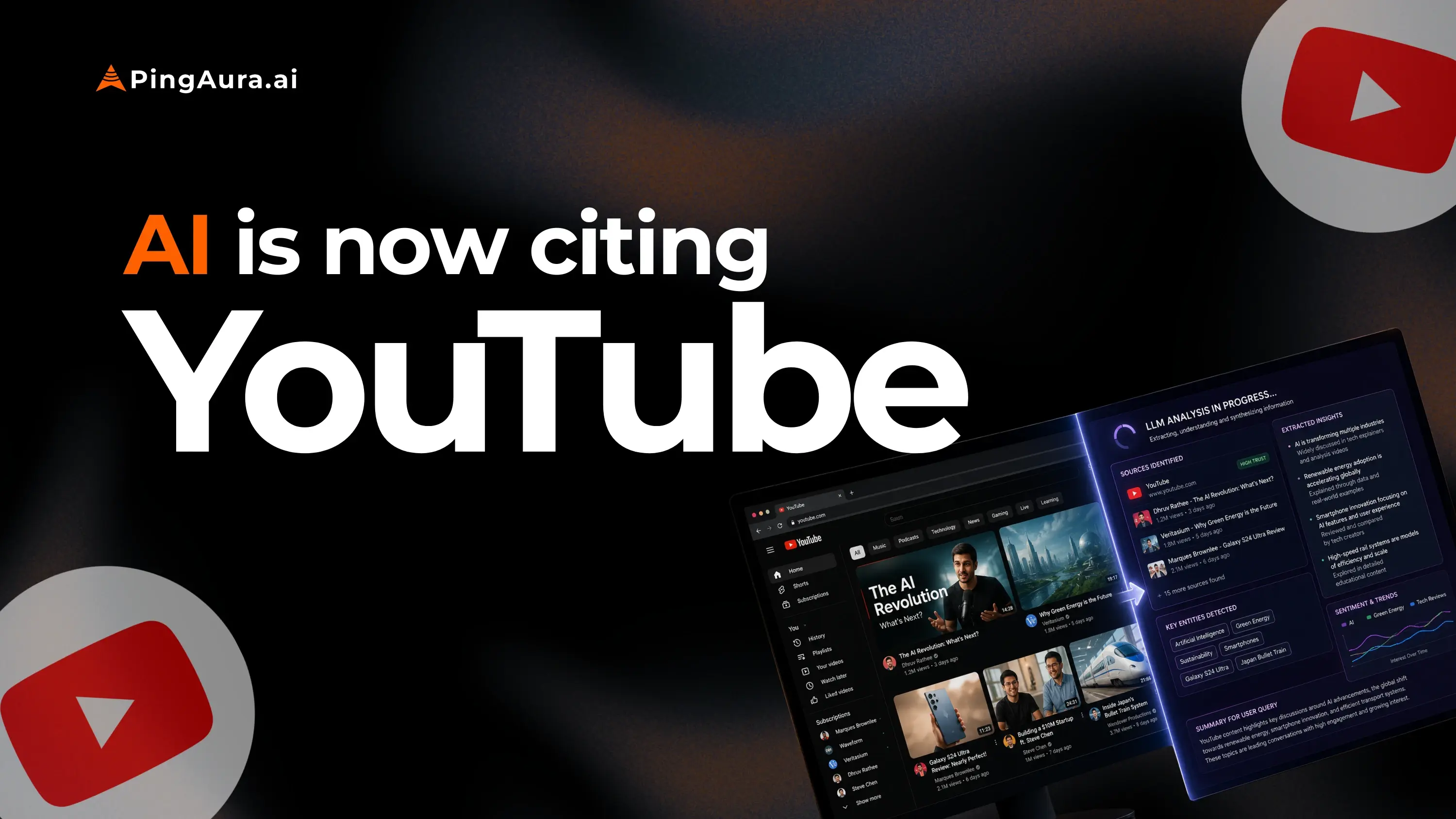
Platforms like ChatGPT and Google AI Overviews no longer just list web links. They pull key facts directly out of spoken video content, then cite the video as the source. Video has quietly stopped being a channel for human viewers only. It has become a primary knowledge base for AI search engines.
That shift changes what "video marketing" means. The question is no longer how many people watched. It is whether an answer engine trusted your video enough to quote it.
TL;DR
- AI engines do not watch video. They read transcripts, titles, descriptions, chapters, and metadata.
- YouTube is cited far more than any other video platform, and accounts for roughly 38 per cent of all social citations in AI search.
- Long-form video wins: about 96 per cent of YouTube citations go to standard videos rather than Shorts.
- Transcript quality is the ranking factor. Clean speech and accurate captions decide whether a model can quote you.
- Success is measured by citation frequency, not view count. A low-view video can still be cited constantly.
Introduction
For most of the last decade, video optimisation meant chasing watch time and click-through rate. Those metrics served a recommendation algorithm whose job was to keep humans watching.
Answer engines have a different job. They need retrievable, verifiable statements to build an answer, and they need them in text. When a model answers "how do I migrate a database without downtime", it is not looking for the most entertaining clip. It is looking for the clearest spoken explanation it can quote and attribute.
That makes YouTube unusually valuable. It is the largest repository of long-form spoken instruction on the internet, and nearly all of it ships with a machine-readable transcript.
How AI Search Engines Read YouTube Videos
AI models do not process video pixels the way a human viewer does. They read the structured text data attached to the media file, much as they read any other web document.
These engines scan the text elements surrounding your clip:
- Spoken transcripts and closed captions
- Video titles and detailed descriptions
- Chapter markers and accurate timestamps
- On-screen text and background metadata
Together these turn a video into a clean, parseable document. Retrieval systems can then pull specific facts out of it, with a timestamp precise enough to deep-link a user to the exact moment.
This is why transcript SEO matters more than production value. A beautifully shot video with garbled auto-captions is, to a language model, an unreadable document.
The Data Behind AI Search Video Citations in 2026
Research from BrightEdge shows how lopsided this has become. YouTube leads all video platforms by an enormous margin, cited roughly 200 times more often than rival video sites.
YouTube also accounts for close to 38 per cent of all social citations across AI search engines. Google AI Overviews now link users directly to video timestamps, dropping them straight at the moment that answers the query.
Format matters just as much as platform. Standard long-form videos capture almost 96 per cent of YouTube citations, with Shorts taking only a sliver. Models consistently prefer deep educational context over brief clips, because a thirty-second video rarely contains a complete, quotable explanation.
The same pattern is showing up across social platforms generally, as we covered in our analysis of Instagram Reels as an AI citation source.
Why LLMs Prefer Spoken Video Transcripts
Educational video happens to match how language models like to consume information. Creators explain complex tasks step by step, with real examples and stated assumptions. Spoken dialogue carries context that terse web copy strips out.
A twenty-minute tutorial contains several thousand words of natural explanation. That density gives a retrieval system plenty of material to match a query against, and plenty of surrounding context to confirm the match is relevant.
The elements models reliably extract:
- Clear problem statements
- Step-by-step procedures
- Deep subject context and caveats
- Practical real-world examples
Short social posts rarely offer this depth. Detailed video does, which is why it earns citations that text-only pages of the same topic often miss.
How to Optimise YouTube for AI and AEO
Modern content strategy increasingly starts with video first. A single clean transcript can power a blog post, a help page, and an AI answer. Treating video as a source document rather than a broadcast is the shift that unlocks this.
Core steps for transcript AEO
Target one search intent per video. Focus on a single question so the model can identify the main point without ambiguity. Videos that wander across five topics get cited for none of them.
Speak clearly to generate clean auto-captions. Clear articulation produces better machine transcription, and better transcription means the engine processes every word correctly.
Add detailed chapter markers with exact timestamps. Chapters create structured sections an engine can reference and deep-link to directly.
Metadata and topical authority
Write helpful descriptions in plain sentences. Summarise what the video actually covers. Avoid stuffing repeated keywords, which adds noise rather than signal.
Fix caption typos before publishing. Review automatic subtitles, particularly for product names and technical terms. A single mistranscribed term can change the meaning of a quotable sentence.
Publish video clusters to build subject authority. Cover related topics across several clips so the engine sees consistent coverage of a domain rather than one isolated video. This is the same clustering logic that works for written content, as outlined in our guide to optimising content for AI visibility.
The Shift to Answer Engine Optimisation
AI search tools now blend web pages, images, and video into a single synthesised answer. Standing out requires content that machines can read and attribute confidently, in whichever format the answer calls for.
Success no longer depends on high view counts. What matters is how often an engine quotes your material when users ask questions in your category.
- Modern AI assembles answers from many media types at once.
- Genuinely useful videos can earn citations even with modest view counts.
- Citation frequency is the metric that predicts long-term reach.
The goal is not clicks alone. It is getting answer engines to trust and reference your knowledge by default.
How PingAura Helps You
PingAura's Citation Tool does not just tell you whether AI is citing your brand. It reveals who AI is citing instead, and surfaces the exact videos, creators, and topics shaping AI-generated answers in your category.
If an engine consistently cites a competitor's YouTube video, PingAura shows you the topic, the intent behind it, and the content gap, so you can produce video that genuinely deserves to be part of that answer. If YouTube is emerging as a trusted citation source in your industry, that is your signal to publish around those subjects, build authority, and raise the odds of being referenced next time.
FAQs
Why are YouTube AI citations growing so fast?
AI search engines rely heavily on video transcripts because videos cover niche topics in unusual detail. A model can read a transcript in milliseconds and extract clear, attributable facts. Video creators also tend to explain complex ideas in simple, sequential steps, which is exactly the structure retrieval systems reward. That combination has made YouTube one of the most cited sources in AI answers in 2026.
Do YouTube Shorts get cited by AI search engines?
Rarely. Roughly 96 per cent of YouTube citations come from long-form videos. Short clips generally lack the depth and transcript length that retrieval systems need to build a confident answer. Longer videos provide richer context and fuller transcripts. If AI search visibility is the goal, standard long-form video is the far better investment.
How does transcript SEO help my brand?
Clean transcripts make your videos easy for AI systems to read, parse, and trust. Engines process written text faster and more reliably than audio, so accurate captions directly improve how well your key points are indexed. When a model can quote your transcript with confidence, your brand appears in the answer itself, bringing qualified traffic without additional ad spend.
Conclusion
AI search has changed how answers get assembled, and YouTube has become a primary source of the knowledge behind them. Video is no longer a parallel channel sitting outside your search strategy. It is part of the retrieval layer.
By treating transcripts as first-class content and optimising them deliberately, you make your video legible to the systems now mediating discovery. Earning YouTube AI citations is how you extend reach into surfaces that never show a traditional search result.
Ready to see who AI is citing in your category?
Find out whether answer engines are quoting your brand or your competitors, and which videos are shaping those answers. Sign up to PingAura.ai today to build your distribution channel inside AI, and let us monetise AI together.