Site health and AI optimisation
The site health agent scans each page on more than seventy parameters and ranks the fixes by how many pages they affect.
Feature · 2:24
What this demo covers
- Every page is scanned on more than seventy parameters across technical health, content quality, and AI engine optimisation.
- Checks include H1 and H2 structure, schema markup, FAQ blocks, structured content, meta descriptions, E-E-A-T and authority signals, the llms.txt file, and LCP, FCP, and CLS.
- Fixes are prioritised by impact, so a slow LCP affecting 154 pages ranks above a one-page issue.
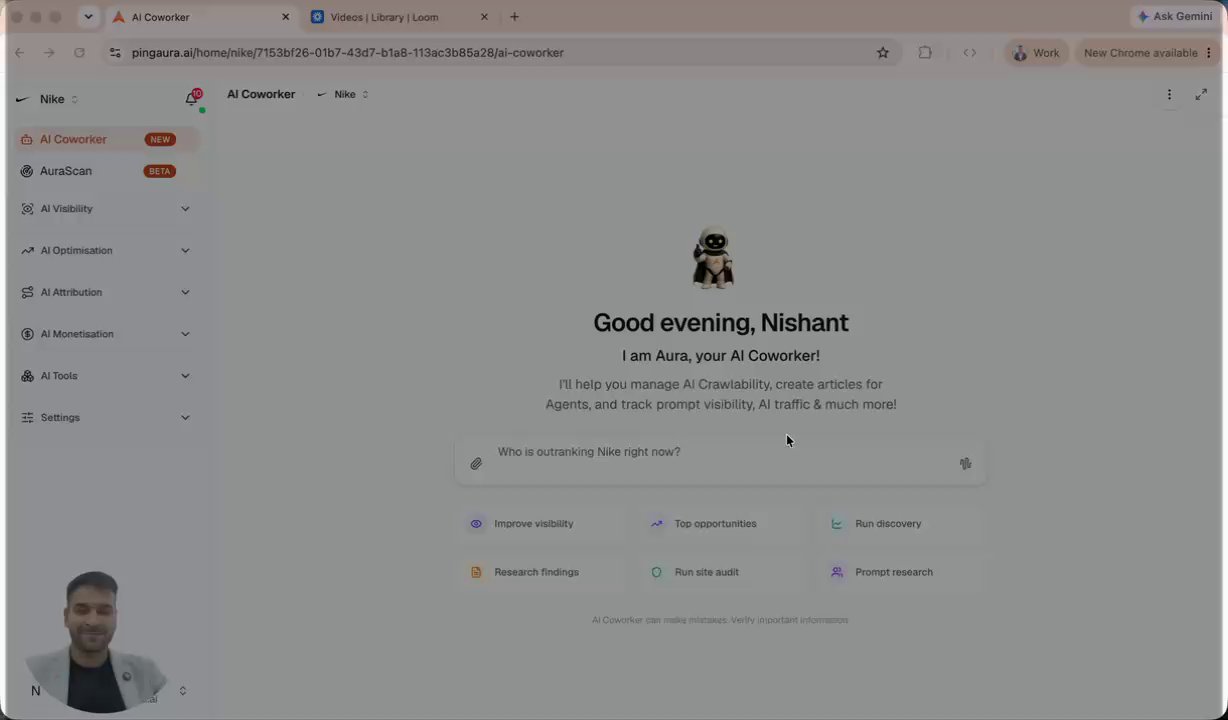
- Ask the AI Coworker about any issue and it returns a step-by-step fix.
- Roughly 35% of your AI visibility score and crawlability depends on site health.
- Add pages the sitemap has not synced, and scan up to 5,000 pages depending on your plan.
In this demo
- 0:00What the site health agent scans
- 0:20The parameters it checks
- 1:02Priority fixes ranked by impact
- 1:08Asking the AI Coworker for the fix
- 1:45Why site health drives AI visibility
Frequently asked questions
- What does the PingAura site health agent check?
- It scans each page on more than seventy parameters across technical health, content quality, and AI engine optimisation, including heading structure, schema markup, FAQ blocks, meta descriptions, E-E-A-T signals, the llms.txt file, and Core Web Vitals.
- How much does site health affect AI visibility?
- Around 35% of your AI visibility score and crawlability depends on site health, which is why fixing it lifts citation rates across AI engines.
- How many pages can be scanned?
- Up to 5,000 pages, depending on your plan. Pages the sitemap has not synced can be added manually.