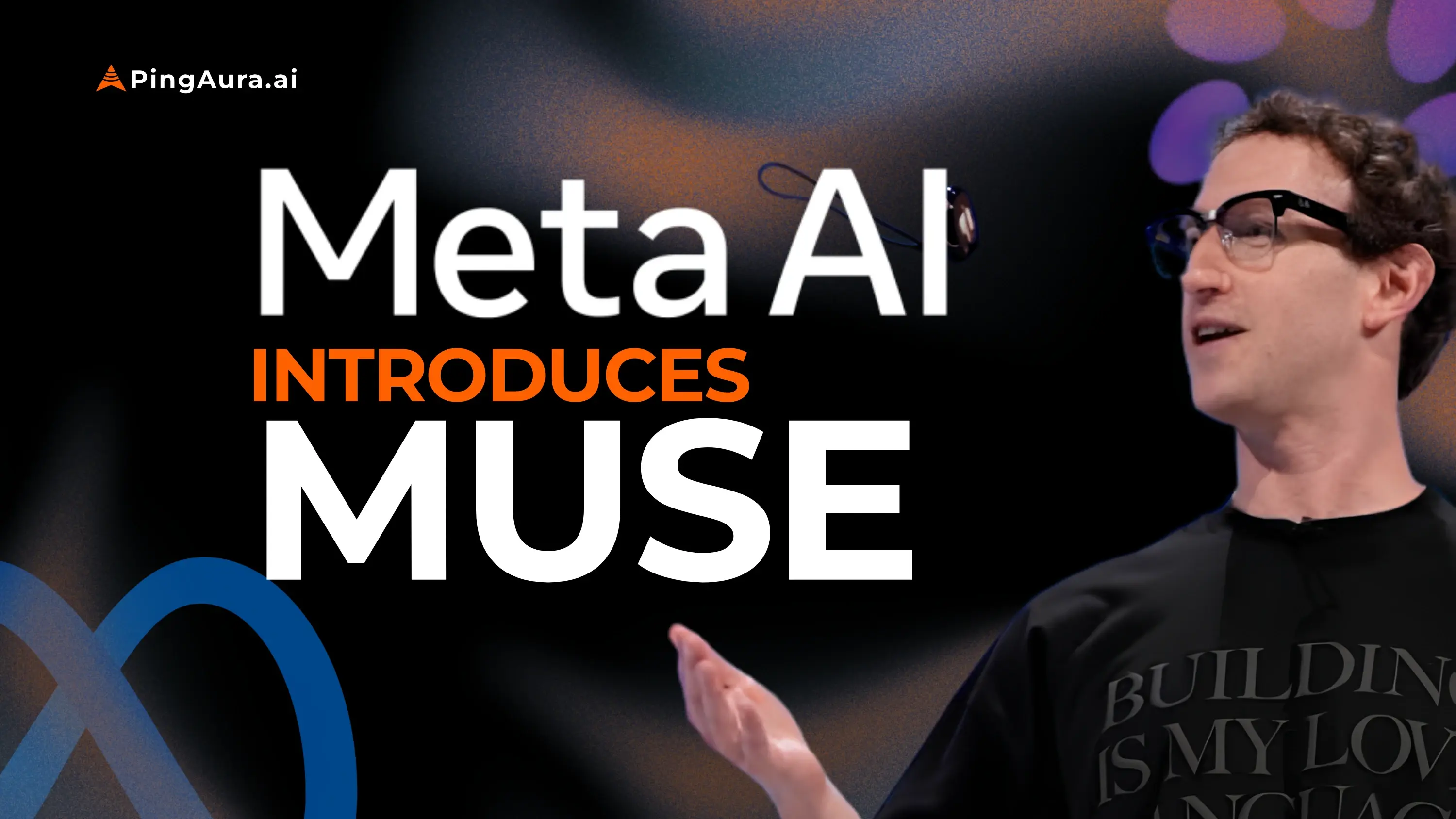
Meta launched Muse, its dedicated personal AI agent, in the United States on September 8, 2026. Muse is designed to work towards goals across a persistent workspace, browser and connected services. Meta's launch announcement describes assistance with tasks such as shopping and planning.
For brands, this raises a practical question: can an agent find accurate information about your products and check it against a customer's requirements? Answer Engine Optimisation (AEO) means improving how a business can be discovered and represented in AI-generated answers. Agent-led tasks add possible comparison and transaction workflows to that work.
The commercial implications below are PingAura's analysis, not a Meta ranking specification. Clear data and usable pages can help research; they do not guarantee that an agent or customer will choose your business.
What Is Meta Muse?
Muse is Meta's dedicated personal agent, with a persistent workspace and proactive task management. It is powered by the multimodal Muse Spark model and can use a cloud computer and browser to carry out tasks. Meta describes a separate Sentinel agent that checks outgoing data as part of its safety approach. Sources: Muse launch and security overview.
Muse and Meta AI should not be confused. Meta AI also has action-taking features: Meta announced planning, connected apps, slides and task execution in July. Muse's dedicated workspace and ongoing task management distinguish its positioning. Meta's July announcement.
Confirmed capabilities and their limits
- Memory and preferences: Users can tell Muse their preferences to guide future work. Review what it remembers and correct mistaken assumptions.
- Voice interaction: Meta describes voice tools for communicating with the agent.
- Background work: Muse can continue tasks and surface meaningful progress, changed circumstances or requests for approval. It does not return only when approval is needed. Muse design overview.
- Payments: Link by Stripe is documented in the launch announcement. Shop Pay is described as coming soon in the September 30 update; do not treat every announced payment connector as already available.
- Privacy controls: Meta says Muse conversations and virtual-machine data are not shared with Meta ad systems, and describes a model-training opt-out. This is a specific product statement, not a guarantee about all connected services' practices. Muse launch.
Muse has a free usage allowance and paid subscriptions for additional usage. Check the current product information and app for plan details.
Launch Timeline and Availability
Muse's US launch is confirmed, as is a native Mac app. Exact rollout timing and market access should be checked in Meta's current product information rather than inferred from a fixed country list. Launch announcement and Mac download page.
| Date in 2026 | What Meta announced |
|---|---|
| September 8 | Muse's US launch; the launch materials also describe Shopify catalogue access |
| September 23 | Connect updates, including forthcoming glasses support and an agent email address; Expedia was described as coming soon, with retail and payment connectors being added |
| September 28 | Meta Enterprise Platform, led by Chief Enterprise Platform Officer CJ Desai |
| September 29 | Muse for Small Business, with connections including Asana, Zoom, Intuit QuickBooks, Box, Canva, Slack and Meta business tools |
The September 23 row describes announcements, not a claim that every capability was live that day. Sources: Connect recap, enterprise platform announcement and Muse for Small Business.
These business offerings also show why Muse should not be reduced to consumer shopping. Its scope overlaps with workplace agents such as OpenAI dots.
Why Personal Agents Matter for Brands
Meta positions Muse around completing goals rather than only returning information. A customer could ask for help comparing products, planning travel or managing a task across services. An agent's ability to complete that goal still depends on available integrations, permissions and the services involved.
Meta's existing consumer apps offer familiar places to interact with AI, and subscriptions provide a route to additional usage.
From a brand's perspective, product comparisons may happen before a person directly visits the store. A practical response is to publish information a researcher can verify: price conditions, stock, variants, delivery areas, return policies and relevant product limitations.
A clear page is one useful source among many. Selection also depends on the customer's choices, competing options, trust, availability and permissions.
How to Approach Using Muse
Start with the current Muse product information and download options. Availability and requirements vary by market; check access in your region before planning a workflow.
| Step | Practical action | What to review |
|---|---|---|
| Check access | Use a currently supported app or web entry point | Market availability and current plan terms |
| Connect services | Link only the accounts needed for the goal | Permissions and whether sending or purchasing is enabled |
| Describe the outcome | Give your budget, constraints and deadline | Missing details that could change the result |
| Share preferences | Tell the agent relevant preferences | Accuracy of saved information |
| Review consequential work | Check proposed purchases, messages and conclusions | Current prices, recipient details and approval settings |
| Maintain the workspace | Correct assumptions and review remembered details | Whether access and context remain appropriate |
Security controls do not eliminate errors. Meta's security and safety explanation describes its approach; review important details before relying on task results.
How Muse Could Affect AEO and SEO
Fewer direct human visits do not mean no website requests
An agent may browse merchant pages or use connected catalogues while the customer stays inside an agent interface. “Zero visit” is useful only if it means no direct human visit. It does not mean the merchant receives no agent requests, and it does not establish that every discovery becomes a purchase.
Keep user sessions, agent requests, citations, identifiable referrals and transactions separate when assessing impact. Each is a different signal.
Make product information readable and current
Use stable product URLs, accessible navigation and accurate descriptions. Keep prices, availability, variants and delivery conditions consistent across pages and feeds. Structured product data should reflect information users can verify.
Review genuine technical problems such as failed page loads or inaccessible product details. This is ordinary site usability and data maintenance, not a requirement for perfect HTML or a guarantee that small images, a special schema or a certain writing style will win agent selection.
Answer specific customer requirements
A customer might ask for a product within a budget, available in a particular size and delivered to a specific region. Pages that explain those constraints can help an agent assess the options. They cannot promise a win every time: price, stock, competition and user preferences still matter.
Improve evidence beyond the first-party website
Keep business facts accurate in relevant listings and reliable third-party sources. Explain what your products do and cite evidence where appropriate. A blocked first-party page does not necessarily make a brand undiscoverable through other sources.
Measure observable activity
Use identifiable AI referrals, consented analytics, server or bot logs, and conversion evidence where available. These provide partial measurements, not visibility into a customer's private agent conversations.
GA4 can help assess observable sessions and conversions; Search Console reports search performance. Neither proves complete attribution for every autonomous-agent interaction or transaction.
Connect improvements to PingAura workflows
PingAura's public platform describes visibility, citation, site-health, article, commerce-readiness and analytics capabilities. These workflows can help teams prioritise improvements; they are not Meta ranking factors, and their scope depends on the current offering.
| Brand task | Why it can help | Relevant PingAura workflow |
|---|---|---|
| Review technical access | Find problems affecting reading and retrieval | Site Health |
| Explore useful questions | Cover customer requirements without assuming access to private prompts | Prompt Research |
| Update product explanations | Keep answers specific and verifiable | Article workflows |
| Compare observed visibility | Identify competitor and citation gaps | Visibility and citation analysis |
| Assess commerce readiness | Review product data and protocol readiness | AI commerce |
| Review observable referrals | Understand measurable sessions and conversions | AI traffic analytics |
Commerce readiness is preparation, not proof of a live Muse checkout integration. See PingAura's platform overview for the current offering.
FAQs
What is Meta Muse?
Muse is Meta's dedicated personal AI agent, designed to work on goals using a persistent workspace, browser and connected tools. Meta's launch announcement describes its capabilities and rollout.
Is Meta Muse the same as Meta AI?
They are distinct products, but both have action-taking capabilities. Muse emphasises a persistent personal workspace and proactive task management; Meta AI also supports tasks and connected apps. Meta's July announcement.
Is Meta Muse available in India?
Availability varies by market, and the sources reviewed here do not establish a complete current country list. Check Muse's current access information for your region.
How much does Meta Muse cost?
Muse has a free usage allowance and paid subscriptions for additional usage. Check the current product information and app for prices and limits; exact tier amounts and token allowances are not verified in this guide.
What model powers Muse?
Meta describes Muse as powered by its multimodal Muse Spark model. That identifies the underlying model, without guaranteeing accuracy or successful completion of every task. Muse launch.
How does Muse affect AEO?
Muse creates another possible route for agent-led product research and tasks. PingAura's analysis is that accurate product data and verifiable answers can help evaluation; Meta has not published a ranking formula that guarantees brand recommendations or transactions.
Does Muse use my data for ads?
Meta says Muse conversations and virtual-machine data are not shared with Meta ad systems. Connected merchants and services may have separate data practices, so this statement should not be expanded into a guarantee that every task is free from ad tracking. Meta's launch explanation.
Conclusion
Prepare for agent-led discovery by improving information a customer or agent can actually check:
- Keep prices, stock, variants and delivery conditions current.
- Ensure key product pages work with accessible navigation.
- Maintain consistent information across catalogues and business listings.
- Review commerce readiness separately from live connector availability.
- Measure identifiable referrals and conversions, and record attribution limits.
Use PingAura's AI commerce overview to explore readiness work, alongside visibility and site-health improvements.